Get Full Government Meeting Transcripts, Videos, & Alerts Forever!
Get email alerts on the Land Use topic
No spam. Unsubscribe anytime.
Council delays vote on Hopewell South PUD after weekslong legal and affordability debate
Summary
After an extended hearing that pitted the mayor and city legal staff against multiple councilmembers over what changes the council can lawfully require, Bloomington council postponed final action on the Hopewell South planned‑unit development to April 1, 2026. The delay follows disagreement about permanent‑affordability rules and which proposed conditions would amend the certified PUD under Indiana law.
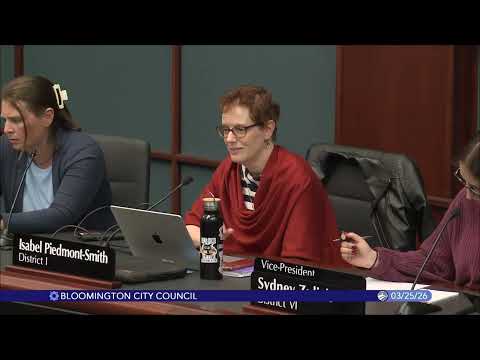
The Bloomington Common Council on March 25 postponed consideration of Ordinance 202606, known as the Hopewell South planned‑unit development (PUD), after more than five hours of testimony and legal argument about what conditions the council can lawfully impose.
Mayor Kerry Thompson, speaking for the petitioner, urged the council to adopt the PUD as certified and said the project "is not my project. This is not council's project. This is and has been our community's project," stressing that the proposal is the first phase of a larger neighborhood intended to emphasize walkability and affordability.
Margie Rice, corporation counsel, told the council that Indiana law severely limits council‑initiated amendments to a PUD the plan commission has certified. "Indiana law has made it clear that a legislative body in Indiana must either reject or adopt in its entirety as certified a PUD ordinance that has been adopted by a plan commission," she said, adding that while reasonable conditions are sometimes allowed, several of the council’s 13 proposed conditions "contradict the current PUD language or exhibits or make amendments to what the plan commission approved."
Council members disputed that reading. Several said the council has routinely attached reasonable conditions to PUD approvals in prior years and that, where the petitioner agrees, changes can lawfully be adopted. Councilmember Stassberg expressed concern about preserving long‑term affordability, saying the city should "ensure that there is as much affordability as possible for as many people as possible," and asking for clearer commitments in the PUD text. Vice‑President Zulich urged action to move housing forward, saying, "The people of this city deserve results."
The council voted 6‑3 to postpone the ordinance until its April 1 meeting, after motions and successive votes on individual "reasonable conditions" produced mixed results: the council approved several clarifying conditions and sustainability measures (including a building‑electrification requirement), but rejected or deferred more contentious affordability language that would have imposed a larger permanent‑affordability package than the certified PUD specified.
Members of the public, affordable‑housing providers and local mortgage lenders addressed the council during the evening. Habitat for Humanity's housing director described using silent‑second mortgages and rights of first refusal rather than deed restrictions; local lenders warned that some deed‑restriction models can limit resale marketability and make mortgages harder to obtain.
Next steps: the council rescheduled final action on Ordinance 202606 for April 1, 2026. Pending that session, city legal staff and council members signaled they will continue negotiating which conditions can be documented as clarifications to the certified PUD and which would require the petitioner’s express assent or a separate amendment process.