Get email alerts on the Drought And Water Supply topic
No spam. Unsubscribe anytime.
Authority reports stressed supplies and emergency river‑pumping authorization during drought
Summary
Authority staff told the board prolonged low river flows have limited withdrawals, triggering an emergency order effective March 18 that allows limited pumping at flows down to 50 cfs to supplement ASR recovery and meet regional demand.
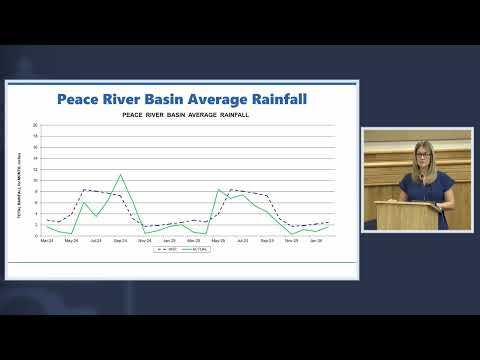
Katie Gilmore, the authority’s staff hydrologist, told the Peace River Regional Water Supply Authority on April 1 that two years of below‑average rainfall left river flows below the normal minimum for withdrawals for months and reduced reservoir storage. “Flow has remained below the minimum for withdrawal since early November,” she said, and that prolonged low flows forced operations to rely on ASR recovery and emergency measures.
Gilmore said the authority requested and received an emergency order executed March 18 that modifies the river diversion schedule and allows pumping at flows as low as 50 cubic feet per second. “This order was executed on March 18, and it allows us to take some water at flows as low as 50 cubic feet per second. Down to 50, we can take about 10 million gallons per day from the river,” Gilmore said. Coupled with pumping from the ASR system (about 18–20 million gallons per day), the authority was able to meet the region’s typical plant outflow of roughly 30 million gallons per day at the end of March.
Gilmore gave the board specific storage and supply figures: surface water storage in the reservoir system was about 3.46 billion gallons as of March 15, rising to about 3.6 billion by month‑end after limited river pumping and ASR support; ASR storage totaled about 7.4 billion gallons (roughly 4.4–4.5 billion gallons usable). She said that, combined, those supplies equated to roughly 265 days of supply at 30 MGD (about 8–8.8 months depending on daily demand assumptions).
The presentation also reviewed state drought actions: Gilmore said the regional water management entity moved to a phase‑three water shortage order effective April 3, which tightens irrigation windows to once‑per‑week schedules, restricts allowed watering hours, limits restaurant service of water to customer request, and imposes citationing without a prior warning 14 days after the order takes effect.
Gilmore described operational responses taken to stretch supply and reduce demand: early ASR recovery beginning in November, targeted river pumping when quality permitted, lowered system pressure twice (about 5 psi total), inter‑agency coordination that increased production from Sarasota County’s Carlton groundwater facility, and temporary emergency orders that allowed additional pumping from nearby utilities. She said conservation messaging has been expanded through press releases, social posts and bill inserts.
Board members praised staff for early activation of ASR recovery and for interagency coordination. Chair closed the discussion noting the need for rain and for continued monitoring.
The authority made no formal policy change at the meeting; staff said emergency and operational measures will continue while river flows and rainfall are monitored.
AI generated
The text on this page is AI generated. Summaries, highlights, analysis, and video transcripts are all produced from the original source material.
AI can make mistakes, so if you spot one, and we will fix it for everyone.
Note: the source content is unaltered by us. Any content source we link to, be it a video, an audio recording, or a document, is presented exactly as its publisher released it. That publisher is usually a government body, sometimes an individual official or another organisation.