Get Full Government Meeting Transcripts, Videos, & Alerts Forever!
Get email alerts on the Surveillance Transparency topic
No spam. Unsubscribe anytime.
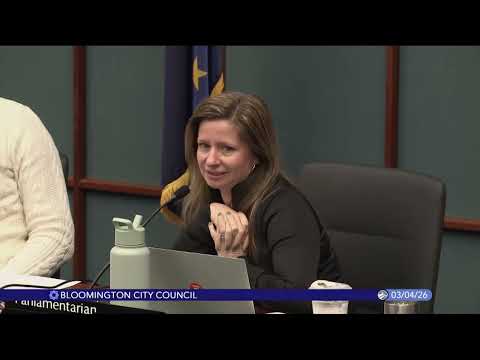
Council unanimously adopts resolution requiring briefing and limits on ALPR program after sustained public outcry
Summary
Following lengthy public testimony and an amendment requiring a six-week deadline for an administration briefing, the Bloomington Common Council passed Resolution 2026-04 (9-0), asking for transparency and a temporary pause on expansion of automated license-plate reader systems.
The Common Council on March 4 unanimously adopted Resolution 2026-04, a measure requesting a public briefing and written materials from the mayor and police chief about the city's automated license-plate reader (ALPR) program and signaling the council's intent to consider an ordinance to govern acquisition and use of such technology.
Councilmember Asari, sponsor of the resolution, said technology that collects large volumes of location-linked data "requires a higher level of transparency and democratic oversight than ordinary municipal tools." Councilmember Piedmont Smith successfully introduced Amendment 1, which added a six-week deadline for the administration to provide the requested briefing and materials; the amendment passed and was folded into the resolution.
Public outcry and themes: The council heard more than an hour of public comment on the resolution from dozens of residents, community organizations and IU-affiliated speakers who urged the city to release contracts, disclose retention and access policies, and, in many cases, terminate or ban the city's contract with the vendor commonly called "Flock." Speakers representing refugee and immigrant-serving organizations, education leaders and students warned the cameras could chill use of public services and jeopardize immigrant safety if data were shared with federal agencies. Tech and security speakers cited published security concerns involving the vendor's cameras and asked for independent audits and immediate transparency.
What the resolution does: The adopted resolution requests a public briefing and written documents describing the ALPR program's scope, costs, retention and access controls, and it calls for an immediate pause on any expansion of that program until the briefing has been completed. Amendment 1 sets a six-week timeline for that administration briefing.
Council reaction and vote: Council members acknowledged the depth of public concern and underscored the need for durable, vendor-agnostic rules governing ALPR and related surveillance technologies. After council debate and public comment, the resolution passed by unanimous roll call, 9-0. Council members said the resolution is a first step and that further legislative action (an ordinance or other binding rules) could follow depending on the administration's response.
Next steps: The council expects a written briefing and a public meeting within the six-week window established by the amendment; council members and community groups said they would use the materials to consider possible ordinances to regulate acquisition, retention, access, auditing and third-party sharing of ALPR data.