Get Full Government Meeting Transcripts, Videos, & Alerts Forever!
Get email alerts on the Housing Development topic
No spam. Unsubscribe anytime.
Council moves Hopewell rezoning to second reading after extensive debate and public comment
Summary
After a lengthy presentation and more than an hour of public testimony for and against the Hopewell South Planned Unit Development, the Common Council voted 6-3 to move Ordinance 2026-606 to second reading on March 25 for further consideration.
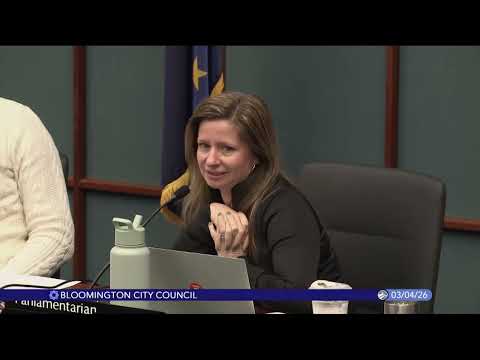
The Bloomington Common Council on March 4 moved Ordinance 2026-606, a rezoning of roughly 6.3 acres to a Planned Unit Development (Hopewell South), to second reading on March 25 after extended presentations and public comment.
The measure, introduced on first reading, would rezone a mix of R4 and RM property within the Transform Redevelopment Overlay to a PUD that proponents say will allow nearly 100 pre-approved homes and create a model for more affordable owner-occupied housing in the city. Mayor Thompson framed the project as a workforce-housing initiative, saying the neighborhood "provides the most affordable new homeownership options in the county with starting prices anticipated at $83,500." The mayor said the PUD is intended as a "living model" that local builders can replicate and as a way to speed delivery without waiting for longer UDO reforms.
Why it matters: Backers said the PUD shortens permitting time by pre-approving designs, lowers developer overhead and creates permanent affordability commitments through the RDC's sales process. Opponents and some council members warned the proposal still leaves unanswered questions about long-term affordability mechanisms, HOA fees, parking and whether delegating final plan approval to staff reduces public review. Director David Hittle and development-services manager Eric Gruelick explained that the primary plat and final approvals will return to the planning commission and that staff delegation for final plan details was an efficiency measure supported by the plan commission.
The public and council debate: The council heard about two dozen speakers during an expanded public comment block. Supporters included housing advocates, local developers and the Bloomington Economic Development Corporation, who argued the PUD will increase housing supply and support local builders. Critics ranged from neighbors worried about parking to housing researchers and public commenters who questioned the durability of affordability protections and the project's assumptions about down payments and HOA costs. Several speakers urged independent evaluation plans and clearer guarantees for long-term affordability.
Council action and next steps: After public comment and council discussion, Councilmember Stossberg and others urged additional conditions; ultimately the council voted to move the ordinance to a second reading on March 25 on a roll-call vote that recorded six ayes and three nos. The council's second-reading consideration will be an opportunity to adopt conditions or amendments to district standards, finalize affordability mechanisms and request additional technical details from staff and the RDC. If approved at second reading and through the remaining platting and permitting steps, horizontal infrastructure work could begin this fall; delay into later permitting seasons would, presenters warned, raise costs and risk losing the current construction season.
The council did not take a final vote to adopt the PUD on March 4; members said they want to resolve several clarifying details before a possible final action.