Get Full Government Meeting Transcripts, Videos, & Alerts Forever!
Get email alerts on the Teacher Compensation topic
No spam. Unsubscribe anytime.
Dozens of Hernando County teachers urge board to convert one-time bonus into recurring pay, press for $2,000 stipend
Summary
Dozens of teachers and staff told the Hernando County School Board on Dec. 9 that a district offer of a $470 raise and a $700 one-time bonus is inadequate, urging the board to reallocate millage funds and approve a $2,000 supplement to retain veteran teachers; the board ratified several contract changes the same night.
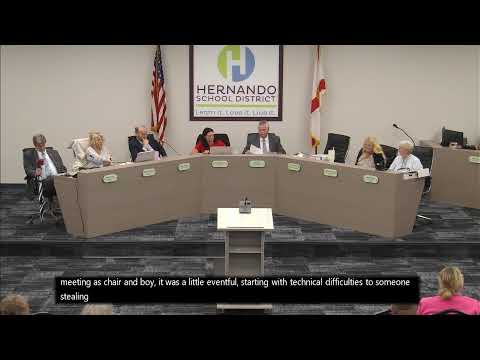
Dozens of Hernando County teachers and staff told the school board on Dec. 9 that a proposed $470 raise and a $700 one-time bonus would not stop experienced educators from leaving and urged the board to adopt a recurring supplement.
"Educators who are at the school sites with the students of Hernando County each and every day deserve more," Melinda Cook, a 23-year Hernando County teacher, told the board during the public-comment period. "More respect, more grace, more support, and yes, more money."
Teachers said the one-time $700 payment — described by district officials as a bonus — is taxed at a higher rate than a recurring supplement, leaving many with less take-home pay. Jennifer Muente, a Spring Hill teacher with five years in the county and 20 years overall, said veteran teachers are effectively earning less today than five years ago and urged the board to fund a $2,000 stipend she and others say would cost roughly $3.3 million.
"Imagine dedicating 20 years to your profession you love only to earn less today than you did five years ago," Muente said. "We are asking you to fund the additional $2,000 stipend that has already been a concession by the union as a critical retention measure."
Speakers repeatedly pointed to millage carryforward funds as a potential source for supplements. Several commenters asked the board to explain how roughly $6,065,574 in millage carryforward (as referenced by a speaker during the meeting) will be spent and argued that some of those funds could be reallocated for teacher retention.
Multiple speakers also said bargaining sessions had been limited and poorly transparent. "The number of meetings this year that was held was less," Melinda Cook said, adding that information provided during bargaining had felt "lackluster." Several teachers described attending bargaining sessions and feeling that district representatives were unprepared or constrained from negotiating larger, recurring pay changes.
Board members responded that they had heard the concerns and that some negotiated items had already been approved. During the meeting the board ratified contract changes affecting instructional and non-instructional staff (see "Votes at a glance"). Some board members said they disagreed with approving parts of a contract separately but voted to ratify the items before them, recording votes of 5-0 on the ratifications.
District officials emphasized limits on their authority and noted the district's dependence on state funding; in discussion board members and administrators cited reductions in state allocations and statutory constraints that shape bargaining outcomes. Union representatives and teachers countered that local decisions about millage and budgeting should be used to support staff.
The meeting included other public-comment topics — including requests for advanced-degree supplements and transportation-staff recognition — and district staff promised follow-up on statutory questions raised by speakers. The board also announced an attorney-client session for pending litigation and adjourned the meeting at 8:07 p.m.
The public-comment period and the board's ratification of contract changes make clear that pay and bargaining remain active issues for the district; board members said they are continuing to work behind the scenes on negotiations and financial planning.