Get Full Government Meeting Transcripts, Videos, & Alerts Forever!
Get email alerts on the Hurricane Preparedness topic
No spam. Unsubscribe anytime.
Sarasota County officials urge residents to "know your zone" and sign up for alerts ahead of hurricane season
Summary
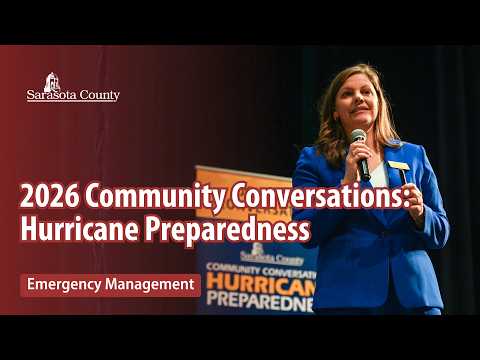
At Sarasota County's second annual "Ready Together" community conversation, National Hurricane Center and state and county emergency officials stressed that storm surge and inland flooding cause most hurricane deaths, urged residents to confirm evacuation zones, sign up for Alert Sarasota County and prepare seven‑day kits.
Sarasota County emergency officials and visiting federal and state experts used the county's second annual "Ready Together" community conversation to press one clear message: know your evacuation zone, sign up for local alerts and build an evacuation plan and kit before a storm approaches.
Jonathan Lewis, Sarasota County Administrator, opened the event by thanking county staff, municipal partners and the school district for hosting the forum and introducing the day’s speakers. "By being ready together, our community will be more resilient and better prepared for storms," Lewis said.
Daniel Brown, a hurricane specialist with the National Hurricane Center, said water—storm surge and inland flooding—remains the leading cause of fatalities in U.S. hurricanes and that new probabilistic products help emergency managers plan evacuations. "Don't get too caught up on the exact track of the storm," Brown said. "Those winds and that storm surge extend far from the center." He described new NHC graphics and a storm‑surge watch/warning product and urged residents to follow local evacuation orders.
Sandra Tafumine, Sarasota County's Emergency Management Chief, recounted a conversation with a Siesta Key resident who did not evacuate during a prior storm and then urged attendees to "always make your decision based on what the information that we're giving you." Tafumine described the county's evacuation mapping (levels A–E), explained how to find a home's evacuation level on scgov.net and announced that three public storm‑surge poles will be installed at local beaches to help residents visualize surge heights.
Tafumine and other county staff also reviewed practical preparedness measures: assemble a seven‑day supply kit (one gallon of water per person per day), register for medically dependent evacuation centers if needed, and sign up for Alert Sarasota County. She said the county has 12 evacuation centers (pet friendly) and emphasized transportation options for medically dependent residents, including BREEZE rally points and county pickup.
Kevin Guthrie, executive director of the Florida Division of Emergency Management, described statewide response capabilities during Hurricane Milton and listed four priorities for recovery: power, fuel, food/water and communications. Guthrie said the state mobilized tens of thousands of personnel for recent responses and urged household preparedness, noting that FEMA assistance is limited: "If you are eligible for everything that FEMA will give you, that's $86,000," he said, but added the typical payout averages far less and "your best defense is insurance."
During a question‑and‑answer period, officials told condo residents that debris from condominium complexes is treated as business‑generated waste and not eligible for public debris pickup or federal reimbursement; condo associations should have contracts and private plans in place. On the county's risk mapping, Brown said the surge maps represent a reasonable worst‑case upper bound and that surge can penetrate bays and creeks — putting some inland neighborhoods at risk.
Officials closed by repeating simple action items for residents: sign up for Alert Sarasota County, confirm your evacuation level on scgov.net, make an evacuation plan, assemble a kit and consider joining or supporting local CERT and volunteer organizations to help neighbors after a disaster. The National Hurricane Center also noted a public Hurricane Awareness Tour stop for the community on Monday, May 4, where residents can see hurricane‑hunter aircraft and meet crews.
What happens next: Sarasota County urged residents to use the QR code and event materials to access local evacuation maps, register for alerts and contact 311 or the county emergency management table for more information.