Get Full Government Meeting Transcripts, Videos, & Alerts Forever!
Get email alerts on the Drainage Jd33 topic
No spam. Unsubscribe anytime.
Blue Earth County approves Judicial Ditch 33 improvements after engineer, DNR reviews
Summary
After presentations from ISG engineers and a DNR advisory, the Blue Earth County Drainage Authority approved the redetermination of benefits, establishment of the Judicial Ditch 33 improvement, and a financing resolution. Staff recommended a $50,000 county contribution to a water-storage component.
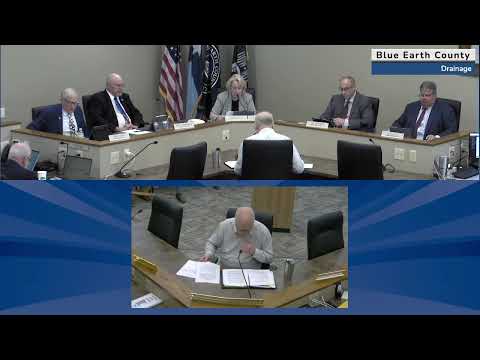
The Blue Earth County Board approved final actions on Judicial Ditch 33 on May 26, 2026, accepting engineers’ and viewers’ reports and adopting a financing resolution to proceed with outlet repairs and wetland storage enhancements.
At the hearing, Blue Earth County Drainage staff (Craig Ostenson) read jurisdictional notices and presented the Department of Natural Resources advisory, signed by Todd Colander, noting the DNR’s review under Minnesota Statute 103E.255 and recommending design changes to meet DNR criteria. Ostenson said drainage staff recommended providing $50,000 from the county’s internal water-storage funding policy toward the JD33 water-storage element.
Appointed engineer Chuck Brandle of ISG summarized the final engineers report. He said the JD33 watershed is roughly 1,200 acres and that the existing outlet is undersized, causing repeated tile failures. The engineer described design changes made to achieve a 0.5-inch-per-day drainage coefficient across the system (down from a short, steep reach previously estimated at 0.74 inches/day), and said the plan includes wetland enhancement and an estimated 11.8 acre-feet of downstream floodplain storage to mitigate flows to the Le Sueur River. Brandle said modeling (InfoWorks ICM) shows the package reduces total runoff volume to the Le Sueur River on average by about 6 percent and reduces peak flow rates.
The engineer described cost options: separable maintenance (repair-only) work and a larger improvement that includes floodplain storage. He reported repair-only costs of roughly $362,000 and an estimated improvement cost of about $541,000; the engineer also said the project meets the county’s cost-benefit and funding policy requirements. He noted the DNR permit process required additional design changes and carries contingencies through 2030 that could oblige the drainage authority to add storage if downstream erosion increases.
An appointed viewer then presented the draft redetermination of benefits. The viewers’ update incorporated current market values and recommended a present-benefit total (as stated in the viewers’ report) of $2,031,998.18 and itemized additional improvement benefits for affected landowners. The viewers reported proposed damages associated with construction disturbances and recommended adopting the redetermination and improvement-benefit calculations.
Public comment was opened and, after multiple calls for speakers, no members of the public addressed the board on JD33. The board then moved, seconded and voted to accept the jurisdictional documents, adopt the redetermination of benefits and findings and orders, establish the improvement, and approve a financing resolution to allow the project to proceed. All motions carried by voice vote.
The board closed the JD33 hearing after the votes. Next procedural steps described by staff include finalizing required easements with participating landowners, completing signed plans for any remaining permit conditions, and, if approved, preparing plans and specifications for bidding.