Get Full Government Meeting Transcripts, Videos, & Alerts Forever!
Get email alerts on the School Budget topic
No spam. Unsubscribe anytime.
Berlin Central School District to Rework Budget After Voters Reject $26.8 Million Plan; Community Urges Protection of Arts and Activities
Summary
After voters defeated the proposed $26.8 million budget, the superintendent told the board it will either re-offer the same budget or present a revised budget in June; staff proposed targeted reductions and residents and students warned a contingency budget would eliminate music, arts and extracurricular opportunities.
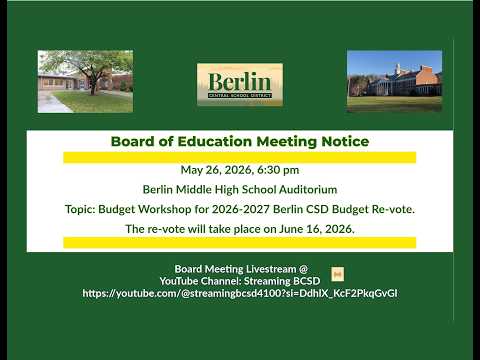
The Berlin Central School District announced it will return to voters in June after the May 19 defeat of a proposed $26,799,780 budget, the superintendent said at a public budget workshop. The board has chosen not to move immediately to a contingency budget and will decide whether to re‑submit the same budget or offer a revised plan before the June 16 vote; a public hearing is scheduled for June 9.
The superintendent opened the meeting by emphasizing students as the budget priority and outlined the options available under New York State law after a failed budget: adopt a contingency budget, re-offer the same budget, or submit a revised budget to voters. She told the audience the proposal had included using roughly $849,145 in reserves and $1 million from fund balance, and that the district had proposed a 2.16% tax‑levy increase but is considering a cleaner 2% option to respond to community concerns.
Why it matters: a contingency budget would limit district spending to mandated items and could eliminate nonmandated extras such as athletics, extracurriculars, field trips and some community facility use—programs several parents, students and staff said are central to student engagement and success.
At the workshop, the superintendent addressed what she characterized as misconceptions about administrative pay. "Our budget is about our students," she said. She explained that changes in accounting put certain costs into the administration line and that a circulating claim of a 12% administrative raise was inaccurate, noting the administrative unit had been recoded to improve transparency and that bargaining units had not settled new contracts. She also said the district reduced its administrator count from 10 to nine by combining roles and by reclassifying one MTSS coordinator to a teaching role so the position could provide reading instruction in classrooms.
To reduce the number the board will consider a set of targeted changes the superintendent recommended to make a revised budget more likely to pass: pause hiring a new secretary (estimated about $40,000 plus benefits), reduce a records‑management line to $8,000, shift a student assistant position from five days to three days (about $13,134 savings cited in the presentation), delay hiring a groundskeeper until the new facilities director can assess needs, and defer selected nonessential equipment purchases.
Parents, teachers and students in the audience urged the board to preserve arts and extracurricular programs. "Music and art have given me life," a middle‑school student said, describing how arts programs provided confidence and structure. A parent told the board that the proposed cuts would take nearly $200,000 from student and support services while the administrative line rose, arguing the district should reinvest administrative funds toward classroom staff. A performing‑arts teacher provided program numbers—she said 129 students participate in ensemble programs and warned that trips, adjudicated events and proposed AP arts coursework could be lost under a contingency plan.
Officials acknowledged questions from residents about where the budget numbers come from and how the district spends what it projects. One commenter asked the administration to show budget‑to‑actual spending comparisons; a district finance presenter said some of the projected increase reflects items such as health insurance and retirement costs and reiterated the need for clearer budget versus actual reporting in future materials.
Next steps: the board will meet to finalize whether it will present the same budget or a revised package in June. The district posted that the public hearing is set for June 9 and the vote for June 16 at the Berlin Middle/High School cafeteria; revised levy and reserve numbers will be released before those meetings. The superintendent also said the district is exploring grant opportunities (including energy audits and possible geothermal grants) that could reduce long‑term operating costs.
The board did not take a final formal vote on a revised plan at the workshop; it asked staff to return with updated figures and community feedback ahead of the June public hearing and vote.