Get Full Government Meeting Transcripts, Videos, & Alerts Forever!
Get email alerts on the Noxious Weed Grant Allocation topic
No spam. Unsubscribe anytime.
San Miguel County advisory board debates how to spend $5,800 state noxious-weed grant
Summary
Board members discussed using a $5,800 Colorado Noxious Weed Fund grant to subsidize herbicide and applicator time for private property owners, weighing acreage-based caps, cost‑share percentages and outreach to maximize participation.
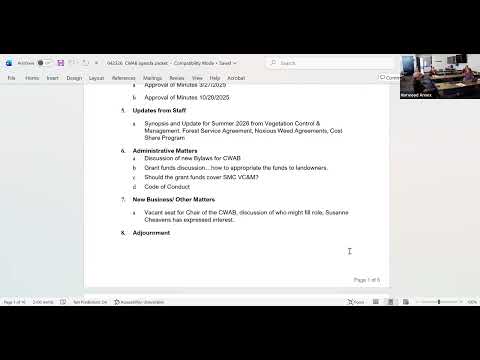
The Citizens Weed Advisory Board discussed options on May 5 for allocating a $5,800 award from the Colorado Noxious Weed Fund to help private landowners pay for weed management.
Julie, the county weed manager, told the board the money "isn't gonna go very far" but could be used to offset herbicide costs and partially reimburse applicator time. She said the state grant reimburses herbicides and applicator hours and that the county’s cost-share program can match herbicide purchases at roughly 50 percent, up to a cap per landowner.
Board members proposed different distribution methods, including a per‑acre scale (for example, tiers such as 0–5 acres, 6–10 acres), first‑come/first‑served lists and splitting the funds between large and small landowners. One member urged setting a cap so a few large properties do not use the entire grant; another proposed reserving some funds for demonstration projects to show the community what coordinated treatment can accomplish.
The manager said the county can stretch the funds by buying herbicide at a government discount and that the grant could reimburse some of the applicator’s time: "So we could use the cost share for the chemicals with herbicides, but we can use the grant funds to pay for the cost of . . . at least a portion of the applicator's time." The board discussed setting a cap such as $500 per landowner as an example to maximize participation.
Members also discussed logistics: outreach via press releases and local papers, listing the program on the county website and providing paper copies for those who need them. Several members urged offering education or applicator‑training events to increase uptake. Staff emphasized the application process is on the county site and that staff would prepare allocation scenarios for the next meeting.
The manager said a waiver will be required for county treatments on private land to limit liability, but emphasized that voluntary participation would not be used as a basis for enforcement.
Next steps: staff will draft allocation scenarios (caps and percent matches), finalize waiver language with the county attorney, and return proposals at the next board meeting for the board to choose a distribution approach.
Ending: The board did not finalize an allocation method at the May 5 meeting and asked staff to return with concrete scenarios for member approval.