Get Full Government Meeting Transcripts, Videos, & Alerts Forever!
Get email alerts on the Environment Cleanup topic
No spam. Unsubscribe anytime.
DOE officials say contamination at Santa Susana Field Lab is localized; outline $10 million FY27 request
Summary
Department of Energy Office of Environmental Management staff updated the community on cleanup progress at the Energy Technology Engineering Center (Etech) at Santa Susana Field Lab, saying site‑related contamination is localized, ongoing monitoring shows no evidence of off‑site migration, and Etech is budgeted $10 million in the FY2027 EM request.
Wendy Lowe, facilitator for the session hosted by the Department of Energy (DOE) Office of Environmental Management (EM), opened a community Connect meeting focused on cleanup work at the Energy Technology Engineering Center (Etech) in Area 4 and the Northern Buffer Zone of the Santa Susana Field Lab (SSFL).
Dr. Josh Mengers, federal project director for DOE’s Etech cleanup, told attendees that DOE’s work is concentrated on localized contamination left from mid‑20th century research. “Our work focuses on the localized contamination, cleaning that up from DOE's previous research at SSFL,” Mengers said, listing soil contaminants including PCBs, dioxins and some heavy metals and site‑related radionuclides such as cesium and strontium. He said DOE has mapped impacted areas with comprehensive studies.
Mengers said groundwater concerns center on chlorinated solvents, including trichloroethylene (TCE), and that the program maintains a network of “over a 100 wells” to monitor groundwater plumes. He pointed attendees to QR codes and handouts that link to DOE’s posted quarterly and annual air and groundwater monitoring reports and the annual site environmental report.
On the question of off‑site risk, Mengers cited a California Department of Toxic Substances Control (DTSC) analysis and decades of monitoring data and said those data show DOE‑related contamination is contained to SSFL property. “We strategically place those wells in the direction of groundwater flow towards and even beyond the property boundary, and the data from those wells have not detected any site related, DOE related, contamination that's leaving the site,” he said.
Asked about direct contact risk, Mengers said ongoing air monitoring around the site perimeter shows air quality similar to regional monitors and stated, “The soil is safe to walk on.” He added that DOE radiation protection professionals performed boot‑scan checks in localized areas with the highest readings and found no transfer of contamination to footwear.
Mengers reviewed the history of remediation at SSFL: early decontamination and decommissioning beginning in the 1970s, later building demolition in the late 1990s and early 2000s, and targeted excavations in areas such as the Sodium Reactor Experiment (SRE) complex and the former Sodium Disposal Facility (FSDF). He said the SRE operated from April 1957 through February 1964 and noted a 1959 incident in which 13 of 34 fuel rods experienced partial melting. The FSDF—used to neutralize sodium components—operated from the mid‑1950s into the late 1970s; Mengers said accidental introductions of radiologically contaminated components sometimes left cesium‑137 and other residues in soils.
Mengers described follow‑up characterization using data from the U.S. Environmental Protection Agency’s 2009–2012 radiological survey of Area 4 and the Northern Buffer Zone. He explained EPA’s two‑step approach—gamma scanning followed by confirmatory soil sampling—and said the spectral analyses helped distinguish naturally occurring radioactive material (NORM) from site‑related fission isotopes. “Of roughly 217 potential gamma radiation anomalies, only about 70 were from site‑related activities such as cesium‑137, cobalt‑60 and strontium‑90, and those locations are very localized, primarily around the Radioactive Materials Handling Facility and a few SRE edges,” Mengers said.
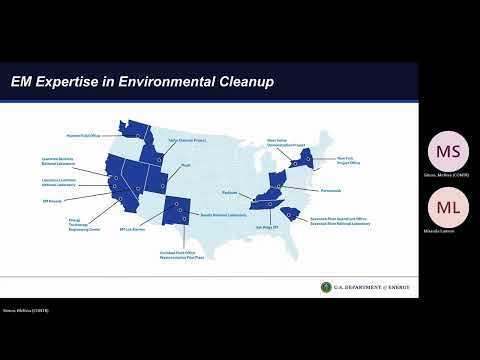
On funding and program context, Karen Edson of DOE EM’s stakeholder and engagement team placed Etech in the national EM portfolio. She said EM has successfully addressed 92 of 107 cleanup sites and that 15 remain active; Mengers showed EM’s FY2027 budget request of $8.1 billion and said Etech’s planned FY2027 allocation is $10 million—roughly one‑tenth of 1 percent of EM’s portfolio—funding groundwater remediation studies, upcoming demolition phases and soils work.
Mengers outlined near‑term technical steps: continued air and groundwater monitoring, soil studies to inform revegetation and stringent final standards, and a groundwater pilot to test in‑situ TCE treatment in selected areas. He emphasized much of the site’s remediation work has already been completed but said characterization and targeted cleanup remain.
DOE staff directed attendees to posted slides, reports and an online Connect page and asked for feedback on the meeting format and topics; they signaled these Connect sessions may be held quarterly going forward. The session was informational and not a public comment meeting. Attendees were asked to sign a contact sheet and to complete an online or paper feedback form if they wished to suggest future topics.
Authorities mentioned: California Department of Toxic Substances Control (DTSC) as lead regulator for final cleanup standards; the U.S. Environmental Protection Agency (EPA) 2009–2012 radiological study; Argonne National Laboratory historical radiological surveys; and DOE EM and the Office of Legacy Management for post‑cleanup stewardship.
The DOE presenters offered contact information and material links for attendees to review monitoring data and reports; they encouraged continued community engagement as characterization and remaining remediation proceed.