Get Full Government Meeting Transcripts, Videos, & Alerts Forever!
Get email alerts on the Road Use Fees Solar topic
No spam. Unsubscribe anytime.
Committee debates uniform roadway permit fee for utility‑scale solar; directs staff and legal review
Summary
The committee discussed creating a uniform road‑use permit fee for large solar and wind projects, with staff asked to quantify actual engineering and administrative costs and for the county attorney to confirm the fee’s legal defensibility under state statute.
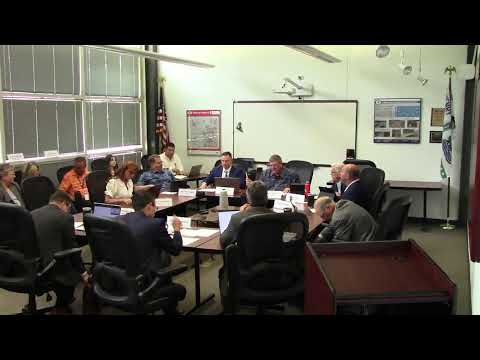
The McHenry County Transportation Committee discussed a proposed roadway permit fee and potential flat fee structure aimed at recovering county inspection and repair costs tied to utility‑scale solar and wind farm construction, and directed staff to quantify the costs and consult legal counsel before returning with a proposal.
Staff and committee members said state actions have limited local authority over siting but allow counties to recoup reasonable costs tied directly to road use agreements. "The permit fee or payment has to be, and I'm quoting directly, equivalent to the amount of actual expenses incurred by the road district or other unit of local government for negotiating, executing, constructing, or implementing the road use agreement," the county’s legal advisor (speaker 17) said, citing the statutory standard discussed in the meeting.
Members referenced existing permit practices: staff said stormwater permit proposals for similar projects have included a $5,000 permit fee and a roughly $150 agreement fee, and that the county’s typical major‑access permit is currently $2,500 with separate charges for construction entrance stabilization and inspections. Several members argued for a simple, uniform fee (for example, a $5,000 flat fee plus an acreage charge) to provide predictability and a funding stream for roadway cleanup and inspections; others and the attorney warned that flat fees unconnected to project‑specific costs could be vulnerable to legal challenge.
The committee directed staff to develop cost estimates (engineering and administrative hours, inspection and cleanup cost models), coordinate with other county committees and departments, and return with defensible figures. Legal counsel also recommended compiling engineer reports tying any road damage to individual projects and developing an approach that can be justified before a court if challenged.
Why it matters: utility‑scale renewable development involves heavy, short‑term construction traffic that can damage rural roads; the county wants a defensible mechanism to recover costs without exceeding the limited local authorities set by state law.
What's next: staff will quantify estimated engineering and administrative costs and work with legal counsel; the committee asked for updated numbers soon so a fee structure can be proposed and defended if adopted.