Get Full Government Meeting Transcripts, Videos, & Alerts Forever!
Get email alerts on the Transportation Safety topic
No spam. Unsubscribe anytime.
Consultants recommend road diet, residents warn Bridge Street backups would worsen
Summary
Consultants presented data showing high speeds, crash clusters and options to convert some four‑lane stretches of Bridge Street to a three‑lane cross section to slow traffic and widen sidewalks; residents at a public forum warned bridge openings and heavy commuter flows could create long backups and new safety risks.
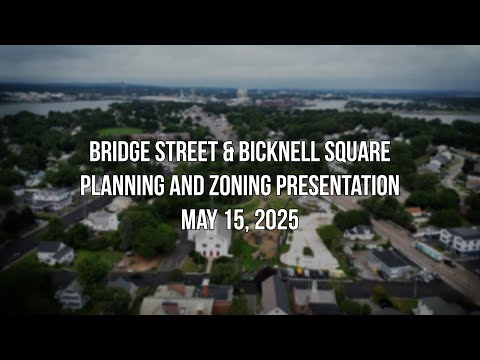
Consultants hired by the Town of Weymouth presented a year‑long planning study for Bridge Street on Thursday, recommending a suite of traffic and pedestrian safety measures including converting select four‑lane sections to a three‑lane roadway (two through lanes with a center two‑way left‑turn lane) to slow vehicles and free space for wider sidewalks, plantings and bike accommodation.
The proposal, presented by Bill Scully of Kimley‑Horn and Associates, is grounded in traffic data showing roughly 29,000 vehicles per day on the corridor and 85th‑percentile speeds that exceed posted limits at several locations. "A lot of the traffic exceeded the posted speed limits between 5 and 15 miles per hour," Scully said, and the six‑year crash record showed 383 reported crashes on the corridor including one fatal and seven serious‑injury crashes.
The consultants said the presence of two safety clusters identified by MassDOT/HSIP—at Bicknell Square and at North Street—could help the town access state and federal safety funding. "The clusters starting to show up gives a possibility for funding in making improvements at those locations," Scully said.
Residents at the forum urged caution. Beth Crawford, a lifelong North Weymouth resident, said the plan would worsen known congestion when the nearby bridge raises for marine traffic: "This thought of dropping us down to 2 lanes is horrific. It is awful. It is a bad idea," she said, adding that bridge openings already back traffic up for extended periods.
Other residents raised operational concerns about lane‑merging and rear‑end collisions if a center turn lane is introduced. Ron Adams, another neighborhood resident, described near misses at merges and questioned whether a 3‑lane conversion would improve safety: "I've had cars speed up to cut me off," he said. Consultants pointed to examples in other towns where 4→3 conversions slowed traffic, noting DOT approval is required and results vary by corridor.
Consultants emphasized that converting pavement to a 3‑lane cross section can create 10–12 feet of additional edge space for sidewalks, planting buffers or bike accommodation and said signal upgrades, protected left turns and mid‑block crossings could reduce crash severity. "If everyone's going on Bridge Street, going 40 or 45 miles per hour, and you're trying to encourage connectivity, that speed becomes a very serious injury or a fatality," Scully said.
The consulting team also highlighted complementary actions—updating signal timing, adding pedestrian countdowns and audible signals, and exploring automated enforcement at the state level—as ways to reduce crashes and encourage lower speeds. They warned that any physical changes to Bridge Street would need collaboration and sign‑off with MassDOT because the roadway is state‑owned and maintained.
The next step: the consultants will post the presentation and a full report to the planning department website; the town encouraged written feedback and comment cards while noting any major design or lane changes must be negotiated with MassDOT and subjected to further operational study.