Get email alerts on the Water Supply topic
No spam. Unsubscribe anytime.
Catskill Watershed attorney explains filtration-avoidance rules, local programs and emerging risks to Delaware County supervisors
Summary
Tim Cox of the Catskill Watershed Corporation briefed the Delaware County Board on the Safe Drinking Water Act’s filtration-avoidance criteria, neighboring watershed models and local programs to support septic and flood mitigation; presenters flagged PFAS and aging infrastructure as key risks and urged residents to contact CWC for septic failures.
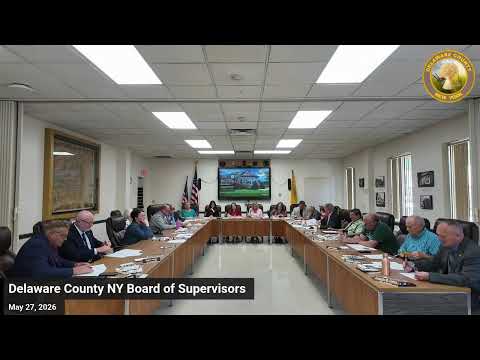
Tim Cox, attorney for the Catskill Watershed Corporation, told the Delaware County Board of Supervisors on June 2 that the 1986 amendments to the Safe Drinking Water Act and subsequent surface-water treatment rules created the legal pathway under which large cities can avoid constructing filtration plants if they demonstrate control over watershed activities.
The overview — delivered at a regular county meeting — reviewed how the 1986 amendments tightened monitoring, added contaminants to the regulatory program and established the surface water treatment rule that, in practice, requires municipalities to demonstrate ownership or enforceable agreements that let them control activities that could harm source waters. "The FAD regs require...ownership or written agreements with landowners that the municipality can control all human activities that can have an adverse impact on source waters," Cox said during his presentation to the board.
Cox contrasted New York City’s West‑of‑Hudson system with other large-city watersheds, noting differences in land-protection levels and governance. He said some systems — such as San Francisco’s Hetch Hetchy — benefit from near-total public lands in protected status, while the New York City watershed combines state-protected (Catskill State Park) land, city-owned parcels and private easements. Cox said New York City has protected roughly 41.6% of the West‑of‑Hudson watershed through a mix of fee purchases and conservation easements.
On costs and treatment, presenters pointed to large capital requirements when filtration is required: Cox noted the East‑of‑Hudson filtration plant treats about 10% of New York City’s supply and referenced a construction figure in the billions of dollars for a comparable large filtration project. "This plant treats 10% of the water supply for the city of New York," Cox said. He added that building and operating a full filtration plant would be expensive and that the city is studying cost estimates.
Cox also described Catskill Watershed Corporation programs that help local communities comply with watershed regulations and support local economic needs: septic assistance and pump-out recommendations (every three to five years), flood mitigation programs, and small-business loans for projects in watershed towns. "If somebody in your account honestly has a septic failure and you're in the watershed, just tell them to call us," Cox said, giving a contact line for CWC.
On emergent technical and regulatory risks, presenters told the board PFAS (so-called forever chemicals) and aging infrastructure are key concerns that could affect filtration-avoidance eligibility or require additional treatment steps. Cox flagged monitoring, land-use compliance and infrastructure maintenance as ongoing challenges.
Deputy Commissioner Paul Rush, who was honored at the meeting for more than 30 years of service, joined remarks about the importance of local–city dialogue and the role of intergovernmental agreements in guiding future negotiations. Rush noted shifts in demand and conservation since the 1970s and outlined that studies are underway to update cost and design assumptions where filtration or major upgrades are considered.
What happens next: Cox and CWC staff offered to be available to supervisors and residents with watershed questions and to supply more detailed materials on program assistance and any upcoming state or federal regulatory changes.
AI generated
The text on this page is AI generated. Summaries, highlights, analysis, and video transcripts are all produced from the original source material.
AI can make mistakes, so if you spot one, and we will fix it for everyone.
Note: the source content is unaltered by us. Any content source we link to, be it a video, an audio recording, or a document, is presented exactly as its publisher released it. That publisher is usually a government body, sometimes an individual official or another organisation.