Get Full Government Meeting Transcripts, Videos, & Alerts Forever!
Get email alerts on the Impact Fees topic
No spam. Unsubscribe anytime.
Summerville council approves first reading of revised impact-fee ordinance, adopts capital improvements plan
Summary
The Summerville Town Council voted May 20 to approve first reading of a revised development impact-fee ordinance and to adopt an accompanying capital improvements plan after a consultant presented draft fees and long-term revenue projections; councilors raised concerns about a large increase to commercial fees and confirmed a process for individual fee appeals.
Summerville — The Summerville Town Council on May 20 approved first reading of a revised development impact-fee ordinance and adopted a capital improvements plan after hearing a presentation from consultant Carson Bice of Tischer Bice on draft fees, projected growth and revenue estimates.
Bice told the council the study applies the legal tests required under the South Carolina impact-fee framework — nexus or need, proportionality and demonstrable benefit — and described three common methodologies for setting fees: buy‑in for past excess capacity, a consumption-based current‑level‑of‑service approach, and a plan‑based approach tied to an explicit funding strategy. "Impact fees are one-time payments designed to offset new development's impact on infrastructure," Bice said. "They're not a tax."
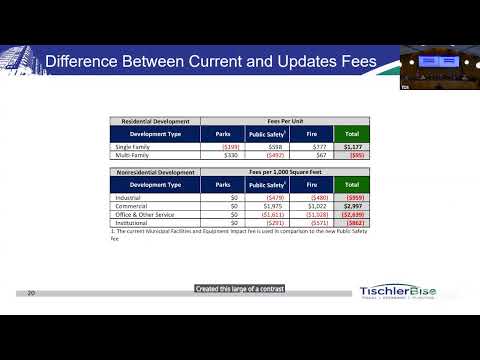
The consultant presented development projections used in the study: about 9,800 new residents, roughly 5,000 new housing units, about 3,200 new jobs and approximately 1,500,000 additional nonresidential square feet over the planning horizon. He also outlined draft fees and sector-specific estimates: draft park-and‑recreation fees of $3,654 per single‑family unit and $2,184 per multifamily unit; draft public‑safety fees raising the single‑family public‑safety component to about $2,416 per unit (an increase of roughly $598) and multifamily to about $974 (an increase of roughly $67). Bice said most nonresidential fees decline under the proposal, but the commercial category would rise notably in his draft schedule.
Council members pressed Bice on the commercial increase, noting that a roughly $3,000 per‑thousand‑square‑foot rise would add tens of thousands of dollars to a 10,000‑square‑foot development. The chair said, "It starts to add up pretty quickly." Bice attributed the change to differences in cost allocation versus the town's prior schedule and said the prior schedule included many narrowly defined retail subcategories that produced very high fees for uses such as restaurants. He noted the ordinance includes a remedy: developers may submit an independent fee calculation (for example, a trip‑generation study) to seek a lower, site‑specific fee if they can demonstrate different traffic or employment characteristics.
Bice also discussed credits intended to prevent double charging — for prior investments, existing debt service and site‑specific developer contributions such as donated land or constructed road segments — and said the South Carolina act requires tracking the timing of projects (proceeds tied to scheduled project dates) and an analysis of any impacts on affordable housing. He added the statute does not define "affordable housing" or specify mitigation requirements; the study therefore reports an effect analysis without prescribing remedies.
On long‑range finance, Bice presented two headline figures from the study: impact‑fee revenue over the planning horizon of roughly $18.3 million and additional non‑impact revenue (for example, bonds) of about $35.8 million to support planned capital spending. (A figure in the presentation transcript for the 20‑year planned expenditures appears inconsistent and was not repeated here because of what staff identified as a likely transcription error.)
After the presentation and a brief council discussion confirming that individual appeals would be handled by town staff (the building department), the council took up formal action. The clerk read the ordinance language and confirmed the planning commission had recommended approval. A motion and second were made for first reading; the council approved by voice vote with no roll‑call recorded. The council then moved and seconded approval of the capital improvements plan tied to the ordinance; that motion also passed by voice vote.
No members of the public signed in for the earlier operating‑budget hearing, and the council closed the public hearing without comments. The special meeting adjourned immediately after the votes.
What happens next: First reading was approved; the council indicated it would proceed with the ordinance as drafted and the accompanying CIP. Developers concerned about specific fee assignments were directed to pursue the ordinance's independent‑calculation process through the building department.
Quotation sources: Carson Bice (Tischer Bice); Chair; unnamed council members and the clerk (as recorded in the meeting transcript).