Get Full Government Meeting Transcripts, Videos, & Alerts Forever!
Get email alerts on the Roads topic
No spam. Unsubscribe anytime.
Hart County road study recommends expanded treatments, proposes $6M–$7M funding scenarios
Summary
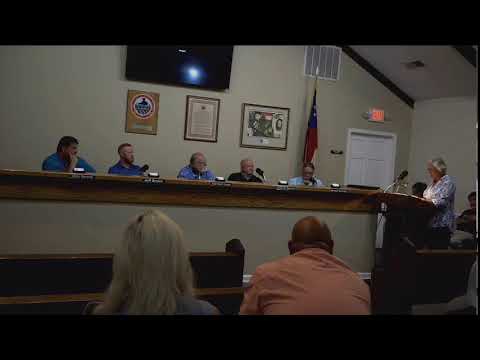
Public works director Jason Spencer told the Hart County Board of Commissioners a pavement assessment found an average PCI of 59 and recommended expanding treatment tools; staff outlined scenarios where $6 million a year would arrest decline and $7 million a year could raise the countywide Pavement Condition Index to about 65 over six years.
Jason Spencer, Hart County public works director, presented a countywide pavement assessment to the Board of Commissioners, saying the county’s paved network totals roughly 522 miles of the 569.7 centerline miles countywide and currently carries an average pavement condition index (PCI) of about 59. Spencer said current practice — mostly mill-and-inlay and overlays funded at about $4 million every other year — will allow the county’s PCI to continue to decline without more funding or different treatment strategies.
Spencer outlined a toolbox of treatments he and consultant InfraHub recommend adding to the county’s repertoire: full-depth reclamation (FDR) for reconstruction, targeted crack sealing to extend life on higher-condition segments, rubberized seal coats, and limited, targeted chip sealing on very low-volume rural roads. He said using the “right treatment on the right road at the right time” would stretch available funds farther than a single-treatment approach.
Spencer summarized modeled scenarios for a six-year program. At $4 million every other year, the county’s PCI would trend downward to the mid-50s by 2030, he said. If the county invested $6 million per year the model projects a modest improvement (mid-60 range), and a $7 million per-year “target driven” scenario would approach a PCI of 65 across the network over six years. “If we were to allocate $6,000,000 per year throughout the county, we would slowly increase our PCI rating,” Spencer said. “For a target driven scenario of a PCI of 65… we would need $7,000,000 a year to achieve that over the course of the 6 year plan.”
Spencer also walked commissioners through the county’s network replacement-value approach used in the planning model and explained how full-depth reclamation can reduce estimated replacement values and annual maintenance needs compared with more expensive conventional reconstruction. Using FDR assumptions reduced the county’s calculated asset base and lowered the annual 1.5% preservation estimate from roughly $7 million to about $5.3 million.
Board members asked technical questions about which roads would qualify for each treatment, right-of-way constraints that limit widening, and whether certain low-volume rural roads could be chip-sealed. Commissioners discussed options to contract chip-seal work versus bringing some operations in-house to save contractor profit margins; Spencer said the county could rent crack-seal equipment or contract specific treatments while building in-house capacity for select operations.
Spencer and staff said the recommended program would also depend on revenues available from a potential transportation special local option sales tax (T-SPLOST) referendum combined with state Local Maintenance & Improvement Grant (LMIG) funds; he cautioned the LMIG contribution is not guaranteed year to year. Commissioners requested a detailed spreadsheet and the printed map Spencer referenced showing estimated costs by road section; Spencer agreed to provide an Excel summary and maps to commissioners by the end of the week.
Next steps: commissioners asked staff to return with more detailed cost breakdowns and a plan for public outreach should the board pursue a funding referendum. The board did not vote on funding at this meeting.