Get Full Government Meeting Transcripts, Videos, & Alerts Forever!
Get email alerts on the Mobile Vendors topic
No spam. Unsubscribe anytime.
Lodi planning commission recommends removing food-truck permit cap, tightens operating rules
Summary
The Lodi Planning Commission on May 27 recommended that City Council amend Chapter 9.18 of the Lodi Municipal Code to remove the citywide numerical permit cap for mobile food vendors, add sanitation and operational standards, and prohibit vendors in the downtown mixed-use (DMU) zone west of the railroad tracks; the commission also voted that the ordinance is not subject to CEQA.
The Lodi Planning Commission voted 4–1 on May 27 to recommend that City Council adopt changes to Lodi Municipal Code Chapter 9.18 governing mobile food vending, including eliminating the citywide numerical permit cap, strengthening sanitation and safety standards, and restricting vending in parts of the downtown mixed-use zone west of the railroad tracks.
City staff said the proposed ordinance revisions were drafted at City Council direction. Johnny Andrews, senior code enforcement officer with the Community Development Department, told the commission the changes would ‘‘eliminate the city wide cap for permitted vendors,’’ add operational standards on noise, queuing and circulation, strengthen sanitation and cleanup requirements, and establish suspension and revocation procedures. Staff advised that the measure does not authorize construction and therefore is exempt from CEQA under Guidelines 15061(b)(3) and 15378.
The proposal would keep county health and fire life-safety requirements in place and retain local business licensing, while replacing a population-based cap formula (currently set at 25 vendors) with no numerical ceiling. Staff said there are currently about 10 people on the waiting list for permits. New food truck permits would cost $150, with renewals at $75 per year, and permit conditions would be used to enforce compliance in the field.
Commissioners questioned how the restrictions would apply to special events and to pop-up vendors that use tents or carts. Staff clarified the DMU prohibition is limited to vendors operating on a daily basis and would not apply to special events such as farmers markets. Pop-up tent vendors and carts are addressed in a separate code section (9.19) and are being considered on a separate track due to different enforcement and public-right-of-way issues.
The draft ordinance would also bar food vendors within 300 feet of single-dwelling residential zones and preserve a path for ‘‘food truck parks’’—sites with three or more trucks—to proceed under a minor-use or conditional-use permit with standard site requirements (permanent restrooms, ADA access, paved surfaces). Staff noted the city has consulted neighboring jurisdictions in drafting the provisions and that, while the code allows food truck parks, none have come forward in Lodi to date.
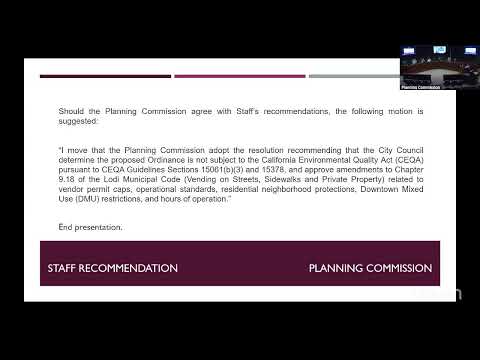
At the close of the hearing a commissioner moved that the Planning Commission adopt a resolution recommending City Council determine the proposed ordinance is not subject to CEQA (Guidelines 15061(b)(3) and 15378) and approve amendments to Chapter 9.18; another commissioner seconded. The roll call vote recorded Commissioner Eddie — yes; Vice Chair Singh — yes; Chair Hicks — yes; Commissioner McNichol — yes; Commissioner Lyden — no. The motion passed 4–1.
Next steps: the Planning Commission forwarded the resolution and proposed code language to City Council for consideration; staff suggested the Council could try a trial period or later amend the code again if market conditions warrant.