Get Full Government Meeting Transcripts, Videos, & Alerts Forever!
Get email alerts on the Dale Anderson Redevelopment topic
No spam. Unsubscribe anytime.
Niagara Transformers outlines phased redevelopment and brownfield cleanup on Dale Road and Anderson parcels; committee recommends negative declarations and asks
Summary
Niagara Transformers (MBT) presented a multipart redevelopment spanning 1747, 1755 and 1746 (and adjacent Anderson parcels) that includes manufacturing additions, shared parking, stormwater pond cleanup and Brownfield/Superfund remediation; the committee recommended negative declarations for 1747 and 1755, and tabled 1746 pending ZBA outcomes and traffic‑safety review.
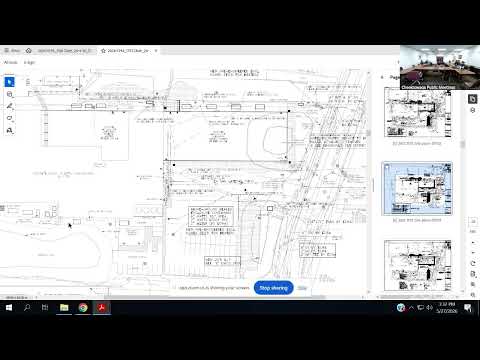
Niagara Transformers representatives and environmental consultant Brian Ham of TRC presented a multipart redevelopment and remediation plan for properties clustered on Dale Road and Anderson (addresses discussed included 1747, 1755 and 1746, plus 24 and 25 Anderson) at the Cheektowaga Environmental Advisory Committee meeting on May 27, 2026.
Project scope and operations: The work includes interior renovations, a roughly 21,000‑square‑foot “winding” addition at 1755, an infill/assembly addition (the ‘‘donut hole’’) and a 23,000‑square‑foot addition tied to 24 Anderson. Company representatives said manufacturing assembly will concentrate at 1755, welding and paint at 1746 across Anderson, and that vehicles and heavy equipment will move between parcels (about one truck per day expected to cross Anderson for late‑stage welding/painting). The applicant said most hazardous liquids and paint operations will be housed indoors; a vapor‑phase capture and recycling system and a waste tank were described as part of future phases.
Brownfield and Superfund constraints: Brian Ham (TRC) told the committee that 1747 is within a New York State Superfund designation and 1755 is a Brownfield cleanup parcel; both parcels carry environmental easements and deed restrictions that limit simple parcel mergers. Testing on existing berms showed the east berm as non‑detect for PCBs and the west berm with trace concentrations well below 50 parts per million, meaning the materials did not trigger specific heightened disposal thresholds; presenters said the plan is to backfill with gravel where berms are removed and to include the required sampling/monitoring under DEC site‑management obligations.
Stormwater and pond management: Due to Brownfield constraints, the project is not proposing infiltration; instead, stormwater will be directed to an existing oversized retention pond that the presenters said was designed to hold stormwater on‑site and will be cleaned and its outlet modified to meet redevelopment water‑quality requirements. The DEC‑led site management requires ongoing surface water and sediment sampling at multiple downstream and pond locations; TRC said it conducts annual sampling and will coordinate with DEC and town staff.
Utilities, fire protection and easements: The applicants explained a sequence for utility work (connect new fire‑water mains and hydrants and verify interior sprinkler connections before disconnecting older services). Because of environmental easements and deed restrictions, the applicants prefer to secure cross‑parcel easements for shared utilities and parking rather than merge parcels, which would require substantial Brownfield paperwork and DEC approval.
Pedestrians and traffic safety: The applicants proposed temporary parking across Anderson during construction and temporary crosswalks; the committee flagged sidewalks, crosswalk placement and truck crossings (large transports and crane movements) for referral to the town’s traffic‑safety body for detailed review.
Committee action and follow‑up: The committee moved to recommend negative declarations for 1747 and 1755 and voted in favor. Members voted to table action on 1746 until zoning‑board appeals, outstanding variances, assessor determinations on front‑lot lines and traffic‑safety comments are resolved. The committee also requested clearer documentation of stormwater sampling, pond dredging plans, truck‑turn studies, and the proposed location/size of any future aboveground tanks.
A spokesman for the applicants said many items are phased over multiple years and that large equipment (transformers) has long manufacturing lead times; the committee stressed conditions and monitoring tied to Brownfield and DEC requirements would need to be satisfied before any construction permits are issued.