Get Full Government Meeting Transcripts, Videos, & Alerts Forever!
Get email alerts on the School Safety Grants topic
No spam. Unsubscribe anytime.
U.S. Department of Education details FY2026 School Safety Enhancement grant priorities; applications due July 28, 2026
Summary
The U.S. Department of Education presented program priorities, eligible activities, application requirements and review criteria for the FY2026 School Safety Enhancement (SSE) grant in a technical assistance webinar, emphasizing a July 28, 2026 grants.gov deadline and that only one application per state is allowed.
A presenter for the U.S. Department of Education outlined priorities, eligibility and submission rules for the fiscal year 2026 School Safety Enhancement (SSE) grant program in a technical assistance webinar, saying, "Applications are due 07/28/2026 and must be submitted electronically through grants.gov."
The department said the competition is limited to state educational agencies (SEAs) — one application per state — and that to meet Absolute Priority 1 the SEA must lead and implement the proposed project. The presenter described Absolute Priority 2 as focused on activities that improve school safety systems and physical security, and listed allowable activities including secure entry systems, deterrent measures, perimeter controls, visitor‑screening infrastructure, emergency communication systems, emergency response plans and active‑threat response training.
The webinar gave an estimated award range of $500,000 to $5,000,000 and urged applicants to develop reasonable, necessary budgets aligned with the scope of work. The presenter reiterated program limits: administrative costs may not exceed 10% of the annual grant award and "Grant funds must supplement and not supplant existing non‑federal funds," and said funds may not be used for construction, renovation or repair of school facilities.
Applications will be evaluated on four selection criteria totaling 100 points: quality of project design (30 points), management plan (30), adequacy of resources (20) and project evaluation (20). The presenter said program performance measures will focus on the number of schools, staff and school resource officers served by grant‑funded activities and advised applicants to structure evaluation plans to collect those data.
Applicants may earn competitive preference points for proposing to serve rural communities that meet NCES locale codes, but those points are optional; the presenter said applicants must demonstrate how they meet rural eligibility to receive them. SEAs that plan to award subgrants must explain whether selection of LEAs will be competitive or noncompetitive and how LEAs will be prioritized. The presenter also required applicants to explain how proposed activities align with recommendations from the 2018 final report of the Federal Commission on School Safety and with the Department of Justice critical incident review related to the Robb Elementary School shooting.
Practical submission guidance included: applicants must use the same Unique Entity Identifier (UEI) they used in grants.gov registration; SAM registration should be completed as soon as possible because SAM data can take 24–48 hours to transfer to grants.gov; and a mismatched UEI can cause rejection. The presenter warned that grants.gov confirmation only acknowledges receipt by grants.gov and does not mean the department has accepted the application. Required file formats include read‑only, nonmodifiable PDFs; the department will not accept PDF portfolios, fillable PDFs, password‑protected files or inaccessible attachments. The presenter also cautioned about file‑naming rules (no duplicate names, maximum 50 characters, no special characters).
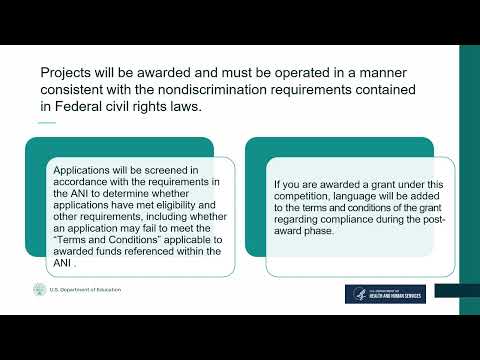
The presenter recommended limiting the application narrative to no more than 15 pages, completing the disclosure of lobbying activities form, following applicable procurement rules, and using whole dollars in budget forms. Applications will be screened for eligibility by federal staff after the deadline and eligible applications will be scored by a panel of three external peer reviewers; all applicants will be notified in writing or by email. Funded projects must comply with federal civil rights laws and will include post‑award terms and conditions related to compliance.
For questions applicants were directed to contact Nicole White, SSE competition manager, at school.safety@ed.gov and to review the SSE program website for updates. The webinar closed with a reminder to submit applications well before the 11:59:59 p.m. Eastern July 28, 2026 deadline to avoid technical issues.