Get Full Government Meeting Transcripts, Videos, & Alerts Forever!
Get email alerts on the Radio System Upgrade topic
No spam. Unsubscribe anytime.
Sawyer County committee weighs building its own radio network or partnering with BugTussel to improve emergency coverage
Summary
The Sawyer County Public Safety Committee heard two vendor proposals to rebuild the county’s radio system: Gencomm proposed a six‑site simulcast system with higher coverage but higher capital cost, while BugTussel offered a fiber‑and‑tower partnership and conduit‑bond financing; staff will return with detailed coverage maps, cost breakdowns and draft resolutions next month.
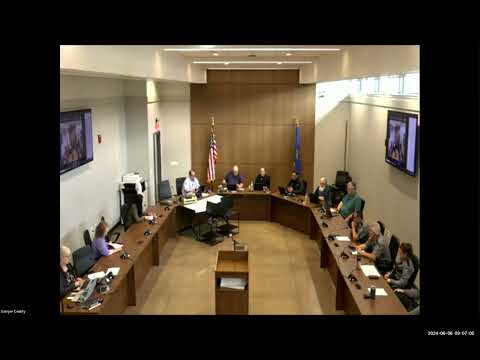
The Sawyer County Public Safety Committee on Tuesday heard competing proposals to replace the county’s aging radio system, with presenters saying the choice comes down to higher coverage for a higher upfront cost versus a lower‑cost partnership that leverages a private fiber and tower network.
Andy, a county staff member leading the project briefing, introduced Gencomm’s and BugTussel’s proposals and said the county will need detailed design and price tags before deciding whether to build and own a new network or to partner with a private operator.
Gary Pelletier of Gencomm outlined a six‑site simulcast design intended to improve portable‑radio coverage for law enforcement, fire and EMS. "It's a simulcast system, which means all the towers transmit at the same time," Pelletier said, adding the design would reduce the number of dead zones where a portable radio cannot reach dispatch. Gencomm’s worst‑case capital estimate for building new towers and shelters, with microwave backhaul, was described as just under $2.5 million.
Pelletier said digital channels provide better outdoor and indoor coverage on portable radios but acknowledged some fire departments prefer analog paging and local fireground simplex channels. "Digital does carry further, but a lot of the fire service communities do not like the digital," Pelletier said. He noted paging remains largely analog and indoor paging coverage can be poor in some rural buildings.
BugTussel’s chief development officer and general counsel, Mitchell Olson, presented the company’s partnership model — a mix of towers, fiber and fixed wireless — and explained a conduit‑bond financing approach that would be issued by a partner county. Olson said the larger regional program price tag is about $16 million and that part of the incentive is a county payment stream that he estimated would total roughly $1.2 million over the program lifetime. "The total sticker price that we're looking for the project is $16,000,000," Olson said.
County staff and committee members focused their questions on coverage tradeoffs for southern Sawyer County, tower height and zoning limits, options to lease existing state or SBA towers, and whether building county towers could be offset by leasing capacity to commercial carriers. Gencomm stressed that a mix of built and leased sites is possible and that coverage can be improved by optimizing tower height and position.
Committee members also discussed the timeline for the state‑run WISCOM rebuild and the potential that waiting for the state could leave the county with several years of poor coverage. Pelletier said the state’s replacement effort is phased and could be years away in northwest Wisconsin; county staff said state grants and discounts for new radios may become available when the state system reaches the region, but that waiting could prolong current coverage and officer‑safety gaps.
The committee did not take formal action. Andy said staff will produce detailed coverage maps, finalize draft resolution language for statutory notice and bond authorization, and return to the committee next month with refined cost figures and options for a combination of county‑built sites and partner towers.