Get Full Government Meeting Transcripts, Videos, & Alerts Forever!
Get email alerts on the Wireless Infrastructure topic
No spam. Unsubscribe anytime.
Upper Chichester zoning board approves 150‑foot cell tower for Conchester Highway site
Summary
The Upper Chichester Township Zoning Hearing Board unanimously granted Rise Up Towers LLC a special exception and dimensional variances to build a 150‑foot monopole at 565 Conchester Highway, with witnesses testifying on safety, coverage benefits for T‑Mobile and post‑construction conditions for screening and testing.
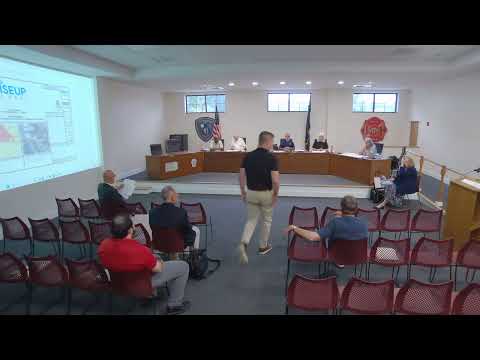
The Upper Chichester Township Zoning Hearing Board voted unanimously Aug. 6, 2020, to approve Rise Up Towers LLC’s application to construct a 150‑foot monopole wireless communications facility at 565 Conchester Highway.
The decision came after the applicant’s counsel and three technical witnesses—contractor Scott Galloway, structural engineer Sean Herrado and radio‑frequency engineer Andrew (Andy) Peterson—testified about site layout, structural safety and electromagnetic exposure, and after the board reviewed published notice and exhibits placed in the record. Chair John Marconi opened the hearing and confirmed required notices and postings were entered as exhibits.
Counsel for the applicant said the tower is needed in part because a T‑Mobile installation on a nearby billboard has been condemned by PennDOT. Andrew Peterson of DBM Engineering said the proposed monopole replaces anticipated service loss from that condemned site and expands strong in‑building coverage to surrounding residential areas. "We're replacing the anticipated loss coverage due to the situation with the billboard," Peterson said, and his coverage maps showed broader areas of improved service from the proposed location.
Engineers also addressed safety and environmental concerns. Sean Herrado, a licensed civil and structural engineer, described the site and said the monopole would be engineered to modern standards and is designed for significant wind loads. "A tower like this is designed for twice what the worst wind in 50 years will ever impose upon it," Herrado testified, and said properly designed and maintained monopoles rarely fail. Herrado and counsel stated the proposed compound is set back approximately 265 feet from the nearest residential property line and about 330 feet from the nearest residential structure, with roughly 200 feet to the residential zoning boundary.
Peterson presented an electromagnetic exposure analysis prepared for the application and described how the analysis applies FCC guidance (OET Bulletin 65) and conservative assumptions. He testified the worst‑case modeled exposures for the proposed installation would be about 1.5% of applicable FCC limits. "Even if we assume all those upper limit exposure assumptions, in this case the levels would be less than 1.5% of the applicable FCC standard," Peterson said. He also said carriers typically operate well below modeled worst‑case levels.
The board questioned witnesses about screening, lighting and inspection. Scott Galloway said the compound will be enclosed by an 8‑foot wooden fence and that existing trees and brush will screen ground equipment; he added Rise Up would plant evergreens if required by the board. Counsel acknowledged the applicant prefers to have a final survey after securing zoning relief but said the applicant would accept a condition to install additional landscaping if trees were removed or cut beyond their control. On lighting, witnesses said no FAA lighting was expected for this location and that only minimal compound lighting (motion‑activated technician lighting) was planned.
On inspection and maintenance, witnesses cited telecom industry standards (TIA guidelines) that require periodic inspections—typically on a one‑to‑two‑year cadence depending on tower classification—and said carriers also perform maintenance and inspections related to equipment upgrades.
After testimony and questions, the board voted to approve the application and to issue written notice of the decision. When polled, board members registered affirmative votes and Chair Marconi stated the board would send written notice to the applicant.
The board record includes the application and several exhibits (publication and posting proof, surveys and technical letters dated Aug. 5) submitted by the applicant. No members of the public offered testimony in favor or opposition during the hearing.
Next steps: the township solicitor said the board would issue written notice of the decision to the applicant and the record will reflect the exhibits and testimony already received.