Get Full Government Meeting Transcripts, Videos, & Alerts Forever!
Get email alerts on the Property Maintenance Law topic
No spam. Unsubscribe anytime.
Residents and officials spar over proposed Pleasant Valley property‑maintenance law at public hearing
Summary
Hundreds turned out for a public hearing on Proposed Local Law No. 1 of 2025 (property maintenance). Residents called the draft subjective and an overreach—particularly landscaping and potential penalties—while the town attorney and zoning administrator said it would be a narrowly applied tool for egregious nuisance properties; the hearing was adjourned to Oct. 6 for further board discussion.
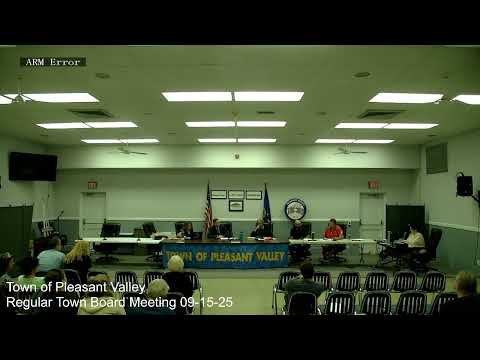
A formal public hearing on Proposed Local Law No. 1 of 2025 — the Town of Pleasant Valley Property Maintenance Law — drew a large turnout and sharply divided public comment on the law’s scope and enforcement.
The board opened the hearing after reading affidavits showing the draft was posted by the town clerk and published in the Northern Duchess News. A legal adviser who helped craft the draft told the audience the measure is intended as a limited tool to abate exterior nuisances — junk, debris and unlicensed vehicles — only after code enforcement has exhausted voluntary remedies. "This is not a situation where the town is intending on going out and regulating how your backyard is supposed to look," he said, adding that the town would charge abatement costs back to the property tax roll and that the law, as drafted, is intended for "really egregious cases." (Presenter)
But many residents and several board members said the draft went too far. Carol Campbell, a former town supervisor, said sections of the draft were redundant with existing code and warned the landscaping and composting language could be enforced subjectively against elderly or low‑income homeowners. "I believe that it infringes on the owner's property rights," Campbell said. "This law, in my opinion, reads like an HOA agreement. We don't live in an HOA. This is Pleasant Valley." (Carol Campbell)
Other commenters urged alternatives. Jamie Chapman asked whether the town could host a junk‑removal day rather than require costly individual cleanups. Greg Palk and other residents asked for clearer, time‑based standards and exemptions for common, benign practices such as stacked firewood or wildflower plantings. "If this law stays broad and subjective, people will be scared," a resident said. (Jamie Chapman; Greg Palk)
Town staff defended the need for the law in a handful of persistent cases. Patrick Lambert, the town zoning administrator, said only several properties have repeatedly refused to comply with orders and that legal proceedings and repeated enforcement efforts are costly. "If we have one more tool to make our job a little bit easier for those few people that refuse to comply, we thought maybe that might be a better idea," Lambert said. (Patrick Lambert)
Board members acknowledged the tension. Several expressed concern about the law's current wording — particularly the landscaping provision and criminal penalties — and asked for edits to narrow scope, add time‑based triggers and remove incarceration language. One councilmember said existing grass‑maintenance code already allows fines; another urged the board to use the law sparingly and to protect vulnerable residents.
The board voted to adjourn the hearing until the Oct. 6 meeting at 7:05 p.m. so members can refine the draft and allow more public input. No final vote on the local law was taken at the session.
What happens next: The hearing resumes Oct. 6; the board indicated it will consider narrower language, clearer enforcement thresholds and possible programmatic alternatives (for example, town‑run junk removal) before proceeding with adoption.