Get Full Government Meeting Transcripts, Videos, & Alerts Forever!
Get email alerts on the Tenant Rights topic
No spam. Unsubscribe anytime.
Atlanta Legal Aid attorney outlines Georgia tenant rights and eviction process at Cobb Law Library
Summary
An Atlanta Legal Aid attorney told attendees at the Cobb Law Library about Georgia tenant rights, covering leases, repair obligations, eviction procedures (including 3‑day notices and 7‑day responses), security deposit rules, Fair Housing protections, and free clinic resources (phone and walk‑in hours).
An attorney with Atlanta Legal Aid told a Cobb Law Library audience that Georgia tenants must generally continue paying rent even when landlords delay repairs, and she summarized how evictions proceed and what remedies tenants may pursue.
The presentation explained why leases and written documentation matter, how to respond to a dispossessory (eviction) filing, and what local resources are available. The Atlanta Legal Aid attorney also provided clinic contact details and cautioned that the session was for general information, not legal advice.
The attorney opened by describing Atlanta Legal Aid as a nonprofit that provides free legal services to people who meet eligibility rules and listed its practice areas, including housing law for tenants. She gave a phone number for intake (404‑524‑5811, Monday–Thursday, 9 a.m.–11 a.m.) and said applications are available online at atlantalegalaid.org/apply. She also explained the Cobb Lawyer in the Law Library walk‑in clinic staffed by Atlanta Legal Aid attorneys offering free 30‑minute consultations, typically Monday–Wednesday with morning and afternoon sessions, and warned that high demand can cause wait times.
She warned attendees to guard against rental scams and recommended verifying listings through authorized sites and completing an in‑person walkthrough before signing a lease. "It's really important to go through authorized sites," she said, and to document the condition of a property at move‑in and move‑out with photographs and receipts.
On lease terms, the attorney urged tenants to check the lease for end dates, renewal terms, early‑termination clauses and late‑fee provisions, and to get any agreed changes in writing. She said landlords may be able to terminate a lease early for lease violations and that most leases penalize tenants for moving out early.
Addressing payment and repairs, the presenter warned: "In most situations, Georgia law does not allow tenants to stop paying rent because the landlord is not making repairs." She distinguished Georgia's approach from other states that allow rent escrow or withholding, and cautioned that withholding rent often leads to eviction filings or credit consequences.
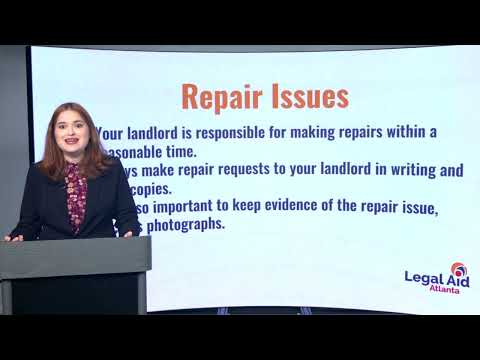
The attorney explained landlords must keep units in a habitable condition and make repairs within a reasonable time, advising tenants to make repair requests in writing and keep evidence such as photos and receipts. Options she described when repairs are not made include negotiating an early termination (putting any agreement in writing), moving out (noting costs and possible fees), filing a complaint with local code enforcement, pursuing repair‑and‑deduct only after significant notice and documentation (but with risk of eviction), or suing for money damages in court. She said a common tenant counterclaim in eviction cases is for failure to repair.
On eviction procedures, she defined the legal term dispossessory as the eviction process and said landlords must follow the courts to obtain a writ of possession before physically removing a tenant. She explained that landlords typically must provide a demand for possession and, in nonpayment cases, a three‑day notice to pay or leave posted on the door in a sealed envelope before filing. She also described "tack and mail" service (posting on the door then mailing that same day) as usually valid.
Tenants have seven days after being served to file an answer with the magistrate court clerk (Cobb's sample form lists options to admit, deny, or deny and file a counterclaim). The attorney advised tenants to list legal defenses on the answer, bring evidence and witnesses to the hearing, and arrive early; she said continuances are rarely allowed and usually reserved for serious reasons such as hospitalization. She noted many eviction cases settle through agreements like payment plans or negotiated move‑out dates, but cautioned that settlements entered into the court record are generally difficult to undo.
If the judge rules for eviction, a writ of possession typically takes effect seven days after the hearing and the sheriff carries out the physical eviction. The presenter also reviewed security deposit procedures, saying landlords have 30 days after move‑out to return the deposit or provide a written explanation for withholding; tenants should provide a forwarding address and document unit condition.
The presentation covered credit and public records: eviction filings are public and can appear on background searches; landlords may report debt to credit agencies, and tenants can dispute such reports. The attorney said motions to seal records are available only in limited situations and depend on judicial discretion.
On discrimination, she summarized the federal Fair Housing Act and similar Georgia protections barring discrimination based on race, color, religion, disability, familial status and national origin, and noted that tenants with disabilities may be entitled to reasonable accommodations. She pointed listeners to HUD, the Georgia Landlord‑Tenant Handbook (DCA), GeorgiaLegalAid.org and Atlanta Legal Aid for further resources and for filing complaints if housing law is violated.
The session ended with the presenter thanking attendees and repeating that the presentation provided general information, not case‑specific legal advice.