Get Full Government Meeting Transcripts, Videos, & Alerts Forever!
Get email alerts on the Utilities topic
No spam. Unsubscribe anytime.
Utilities presenter outlines Senate Bill 64 compliance and major water/wastewater projects
Summary
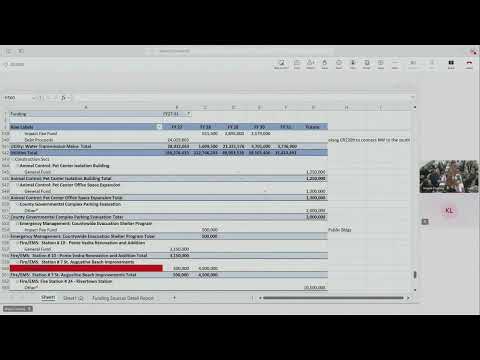
The utilities presenter told the board that Senate Bill 64 compliance will require capital investments through 2032 and identified about $46 million in SB 64-related needs plus multiple large plant and pipeline projects, including an $83 million Northwest wastewater expansion and a $43 million Trout Creek water plant.
Utility leadership (S6) briefed the board on required utility upgrades, asset management needs and financing options tied to recent regulatory and growth pressures. The presenter said compliance timelines and capacity needs make several near-term capital projects a priority.
S6 said compliance with Senate Bill 64 is mandatory and will consume a significant share of the utility CIP; S6 summarized the SB 64‑related capital need as roughly $46 million and described that work as a multi‑year requirement with a 2032 compliance date: “This is something you have to do and comply by 2032,” S6 told the board. S6 added that the utilities program blends reserves, connection fees and bond proceeds and that a $300 million bond program is planned across the next two years to support major investments.
Among large projects S6 highlighted a proposed Northwest wastewater expansion (a 3.7 million gallons per day facility scaled by scenarios) with an estimated $83 million capital need and a Trout Creek water plant project estimated near $43 million that staff aims to have under contract by October and online by 2029–2030. S6 emphasized asset-management programs for wells, lift stations, force mains and telemetry as ongoing needs funded from enterprise budgets and impact fees.
What happens next: utilities staff will refine project schedules, bond and impact‑fee uses and present a detailed financing plan to the board; the board may consider bond authorization and prioritization as part of the upcoming budget cycle.