Get Full Government Meeting Transcripts, Videos, & Alerts Forever!
Get email alerts on the Building Codes Update topic
No spam. Unsubscribe anytime.
Committee advances package to update Philadelphia building codes, approves amendment to energy bill
Summary
The Licenses and Inspections Committee heard testimony and public comment on seven ordinances adopting the 2021 International Codes, approved an amendment to the energy code bill (250644), and reported all seven bills favorably for first reading at council. Debate focused on whether to add a continuous exterior‑insulation requirement and on upfront cost vs. long‑term energy and health benefits.
Philadelphia — The Committee on Licenses and Inspections on Monday heard testimony and public comment on a package of seven ordinances to incorporate the 2021 International Codes into the Philadelphia Building Construction and Occupancy Code and reported the entire package favorably for first reading at council.
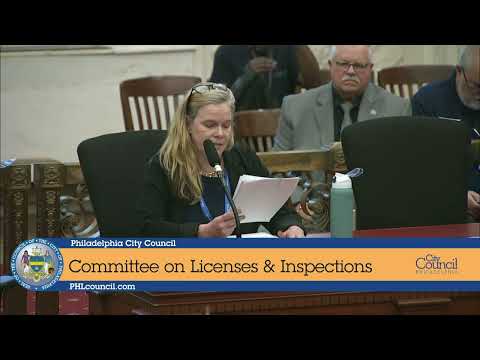
Elizabeth (Betsy) Baldwin, chief code engineer for the Department of Licenses and Inspections, told the committee the bills would bring the city’s Title 4 into alignment with the Commonwealth‑adopted 2021 codes while preserving existing local amendments and adding targeted local changes. On the energy bill, 250644, Baldwin outlined proposed local measures including a mandatory additional energy‑efficiency package targeting roughly a 5% improvement in residential building energy use, stronger envelope and lighting testing and controls, and the elimination of an air‑leakage testing exemption for certain ductwork. “A complete summary of the proposed local amendments has been provided to the committee,” Baldwin said, and offered to answer questions.
The most contested line of questioning concerned whether to include the 2021 code’s continuous exterior‑insulation requirement. Councilmember Gauthier, who chairs the committees on housing and environment, said stronger insulation requirements could lower energy bills and improve indoor air quality for residents with high energy burdens. She cited a city median energy burden of 5.4% (compared with a 2.9% national average) and said that low‑income households face an even higher share of income spent on utilities.
Representing the Building Industry Association of Philadelphia, Mohammad (Moe) Rushdie urged the council not to add mandates beyond the administration’s proposal. He said the BIA supported bill 250644 "as introduced" but warned higher upfront construction costs could compress housing production. Citing a study his group referenced, Rushdie summarized a cost‑to‑savings comparison by saying the modeled increase in mortgage would be about $100 per month while estimated energy savings would be about $9 per month under his referenced assumptions. He also said his analysis used a 6.5% interest rate and estimated an average additional construction cost of about $10,098 per home.
Liz Lankanel, director of the Office of Sustainability, said the office had reviewed net‑present‑value analyses and that outcomes vary by building typology and assumptions about interest and energy prices. Lankanel committed to further analysis with stakeholders, including Green Building United, and noted the administrative process to adopt a local amendment would require a 30‑day posting with the Pennsylvania Department of Labor and Industry before it could take effect.
Advocates urged stronger standards. Emily Pugliese of Green Building United, in public comment, described continuous exterior insulation as a thin foam board applied outside the sheathing that reduces thermal bridging, moisture risk and indoor air problems. “We recommend that council pass legislation ensuring continuous installation is required in our building code,” Pugliese said, while also acknowledging the measure has an upfront cost and suggesting separate legislation if needed.
Architects’ representatives backed the code updates but urged practical compliance paths. Danielle Fleishman of AIA Philadelphia said the package improves verification and accountability by adding two‑stage compliance (proposed and as‑built verification), and encourages heat‑pump adoption and performance‑based compliance pathways while cautioning that added documentation could create administrative burdens for smaller projects.
On related bills, Baldwin explained that 250645 would adopt the 2021 International Plumbing Code with local amendments (including the option to use modern trenchless pipelining for underground repairs); 260391 would update the mechanical code and refrigerant safety requirements; 260392 would adopt the 2021 fuel gas, performance and existing building codes; 260393 would revise administrative provisions to support implementation; 260394 would adopt the 2021 International Building Code with energy‑related enforcement measures such as special inspections for air barriers and duct leakage testing; and 260395 would adopt the 2021 International Residential Code with related updates.
After closing the public hearing the committee moved into a public meeting. Councilmember Scuilla offered an amendment to bill 250644; the amendment was seconded by Councilmember Gilmore Richardson and approved by voice vote. Scuilla then moved that bill 250644, as amended, be reported from committee with a favorable recommendation and that council rules be suspended to allow first reading at the next council session; that motion carried. Councilmember Skoll subsequently moved, and the committee approved, reporting bills 250645, 260391, 260392, 260393, 260394 and 260395 with favorable recommendations and suspending rules for first reading.
What’s next: Each bill was reported to the full City Council for first reading. Committee members and administration staff said they will continue to refine cost‑benefit information and implementation guidance for measures such as continuous insulation.
Reporting note: Quotes and attributions are drawn from testimony and public comment before the Committee on Licenses and Inspections. The committee’s votes were taken by voice and recorded in the committee minutes as “the ayes have it.”