Get Full Government Meeting Transcripts, Videos, & Alerts Forever!
Get email alerts on the Child Welfare Commission topic
No spam. Unsubscribe anytime.
Council committee advances charter amendment to create a Philadelphia Child Welfare Commission
Summary
The Committee on Law and Government voted to report favorably on a charter amendment (bill 260,076; resolution 260,094) to establish a permanent, advisory Philadelphia Child Welfare Commission after testimony from DHS, advocates, and affected families.
Council’s Committee on Law and Government voted to report favorably on a proposed amendment to the Philadelphia Home Rule Charter that would create a permanent Philadelphia Child Welfare Commission to provide public oversight and advisory recommendations on the city’s child-welfare system.
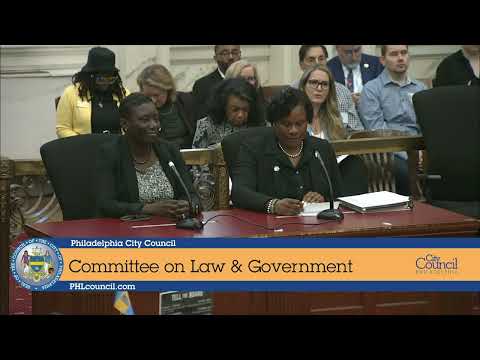
The committee acted after a morning of testimony from city officials, child-welfare advocates and parents. Kimberly Ali, commissioner of the Department of Human Services, said the department supports measures that increase transparency and elevate voices with lived experience but cautioned the commission would be advisory only. "I am Kimberly Ali, commissioner for the Philadelphia Department of Human Services," she told the committee, and she cited recent system data: "As of today, there are 2,248 children in the child welfare placement, which is down from 5,111 in 2020. This amounts to 2,683 less children in care or 56% reduction in the number of children and youth who are in the child welfare placement." She added the commission "cannot investigate individual cases" or access confidential family records.
Advocates urged the charter change as a way to institutionalize public oversight. "A child welfare commission would fill a major void," Stephanie Arbitina, vulnerable youth policy director at Children First, told the committee, urging that the body be permanently embedded in the charter so it cannot be undone by future administrations. Keisha Hudson of the Defender Association and peer advocate Dwayne Price said the commission should explicitly include youth with lived experience and allow compensation for commissioners to remove financial barriers to participation.
Public commenters included parents and advocates who supported a permanent oversight body but cautioned it must act on earlier recommendations. Carolyn Hill, of the grassroots group Give Us Back Our Children, said she worries a new commission could become another layer of bureaucracy unless it is tasked with implementing reforms that reduce removals and keep families together.
During committee questions, members pressed witnesses on the commission’s scope and day-to-day functions. Witnesses described the commission’s potential roles: reviewing public-facing DHS indicators in a regular forum, co-designing policy with impacted families, highlighting systemic barriers (housing instability, workforce turnover, behavioral-health gaps) and recommending budget or program changes.
After discussion, the committee approved an amendment to resolution 260,094 and voted to report the resolution and bill 260,076 from committee with a favorable recommendation. The committee advanced the items by voice vote; members signaled unanimous support in the recorded "Aye" responses.
The legislation next moves to the full council for consideration and, if approved, would appear on the ballot for voter consideration.