Get Full Government Meeting Transcripts, Videos, & Alerts Forever!
Get email alerts on the Local Government topic
No spam. Unsubscribe anytime.
Council advances federal-grant appropriation, hears honorary street, and moves on land-use measures
Summary
On Nov. 12 the council placed a federal-grant appropriation ordinance on third reading and heard resolutions including an honorary street designation for Dr. Edward Williams and a resolution opposing a truck-parking special-use variance; roll-call votes were recorded for these items.
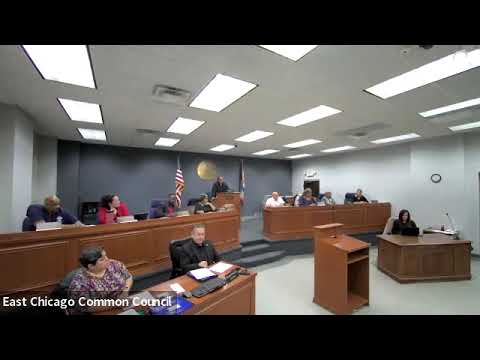
The East Chicago Common Council on Nov. 12 advanced and took votes on several ordinances and resolutions.
Ordinance 25-0020 (appropriations ordinance, federal grants fund 2401) was placed on third reading after a motion by Councilman Monroe and second by Councilman Hill; roll call indicated affirmative votes from the members recorded in the meeting and the ordinance moved forward on third reading.
Resolution 25-0012, an honorary street designation to name Lombardi Street for Dr. Edward Williams, was presented with sponsor names read aloud and received supportive remarks from council members and family members. The council heard the resolution and the record shows the motion to hear the resolution and roll-call participation by members present.
The council also considered Resolution 25-0014, responding to a petition for a special-use variance to allow a truck-parking facility at 1300 West 145th Street. Councilwoman Gonzales spoke in opposition, citing increased semi-truck traffic and safety issues in the affected neighborhood; the resolution as presented would deny the petition and roll-call votes were recorded.
Several other procedural motions were handled on the consent and administrative calendar (acceptance of minutes, accounts payable and payroll warrants, tabling of two second-reading ordinances). The meeting record shows roll-call participation for those routine items as well.
Where roll-call responses were read into the record, the clerk recorded members’ votes by name. The transcript does not uniformly list a consolidated numeric tally for every motion; the meeting record lists individual 'yes' responses from members present in the roll calls reported.
The council adjourned after public comment and closing business.