Get Full Government Meeting Transcripts, Videos, & Alerts Forever!
Get email alerts on the School Budget topic
No spam. Unsubscribe anytime.
Finance Committee reviews state budget framework and flags $2.8 million local cost for one‑time bonuses
Summary
Union County Public Schools finance staff told the committee the General Assembly’s framework would average about an 8% salary increase for certified staff and include a one‑time bonus; district projections estimate a little over $2.8 million in local costs to make eligible but locally funded employees whole, and the county’s proposed interlocal arrangement would hold some supplements pending a joint agreement.
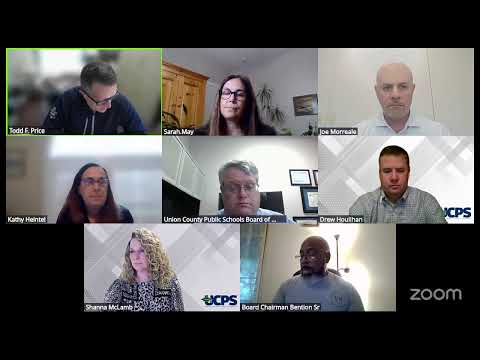
The Union County Public Schools Finance Committee on May 27 heard an update on a newly announced state budget framework and discussed its local impact, including projected pay increases, a one‑time bonus program and how to fund the district’s estimated local share.
Shauna, the district finance presenter, told the committee the General Assembly framework proposes an average 8% salary increase for certified staff, with larger increases concentrated at the 0–10 years experience band (about an 11% average there). She said noncertified staff received a 3% increase to base pay in the framework and that employer retirement matching rates would increase to roughly 25.76 percent as read in the presentation. "We're anticipating mid June for an approval by both the house and senate to be able to go to the governor," she said, and added that the effective date for salary-schedule increases would be July 1.
The presentation also covered a one‑time payment the framework includes for the current school year. Shauna described the proposal as tiered: amounts differ by years of experience and by salary bands for noncertified employees. She warned that the district has not yet received eligibility rules or distribution timing from state offices and that the one‑time payments are separate from the recurring salary-schedule changes. "That July start ... the two are two separate things," she said.
Using preliminary calculations, Shauna estimated the local cost to provide equivalent one‑time payments to staff paid from local, federal or other restricted funds would be a little over $2,800,000. She told the committee there are two primary options to cover that cost: request a one‑time appropriation from the county commissioners or draw on the board’s fund balance. She noted the last audited fund balance was about $7.8 million and cautioned that the district operates on slim margins; the district auditor had recommended a substantially larger balance (discussed in the meeting as on the order of $20,000,000 for two to three months of operations).
Committee members asked for detail on what the state funds versus what the district must support locally. In one example, Shauna said the state formula funds roughly 41 10‑month assistant principal positions, while the district currently employs 103 assistant principals across 53 schools; the shortfall requires local funding for many positions. She also said she would provide a more detailed breakdown of how much of the $2.8 million projection would be covered by federal or other funds versus the local general fund.
The committee discussed practical timing. Shauna said payroll processing and year‑end closeout make it unlikely the district could issue one‑time payments by July 1 even if the state acts quickly; the first large payroll for returning 10‑month staff will be in August. Speaker 6 recommended the finance committee meet again in June if the state acts in mid‑June so the district can finalize numbers and necessary actions.
Members also received a local budget update reflecting the county manager’s proposal. Shauna said the county proposed $148,009,022.22 in operating support, about $4.3 million less than the district’s request of $153,000,003.33. The county manager’s proposal fully funded the district’s capital request (about $20.9 million), but used multiple revenue sources to do so (sales tax, bond proceeds and state capital funds). The county proposal would also hold $3.8 million in reserve for a teacher supplement (described in the county proposal as $1,000 for classroom teachers and $750 for teacher assistants) and transfer $2.7 million to the district general fund earmarked for school resource officers rather than including those dollars in the district’s monthly operating deposits.
Shauna and Dr. Houlihan said they reworked the local allocations to align with the county proposal and still cover mandated increases; the revised plan reduced some special‑population and other proposed increases but preserved a targeted set of supplements. The rework left an unfunded portion equivalent to an additional $1,000 supplement for certified staff that would require further board approval.
Procedural items moved forward: the committee voted to send the revised local budget recommendation to the full board consent agenda for the June 2 meeting, voted to forward budget amendments and transfers included in the meeting packet, approved an interim budget resolution to allow operations to continue while state and local funds are finalized, and approved forwarding an annual Lightspeed (web filtering) contract renewal to the full board. Each motion passed by recorded "aye" votes in the committee.
The committee agreed to schedule further finance committee work in June as necessary and adjourned.
Next steps: staff said they will provide a detailed funding breakdown of the $2.8 million projection, continue to monitor state guidance and eligibility for the one‑time payments, and return to the committee with updated numbers for any required board action.