Get Full Government Meeting Transcripts, Videos, & Alerts Forever!
Get email alerts on the School Construction topic
No spam. Unsubscribe anytime.
Portland officials outline $107 million school plan and $41 million local bond ask to leverage state reimbursement
Summary
Town presenters recommended renovating Valley View and Gildersleeve and addressing secondary-school needs in a staged plan that would ask Portland voters to approve a $41 million bond expected to be matched by roughly $66 million in state reimbursement, producing about $107 million in total work.
Presenter Charles told a joint meeting of the Board of Education and the Board of Selectmen that the district is recommending a staged renovation program that would gut-and-rebuild Valley View, renovate Gildersleeve, move sixth grade to the middle school, and address urgent secondary-school needs. He said the plan would ask Portland voters for roughly $41 million in local bonding to leverage about $66 million in expected state reimbursement for an estimated $107 million in total projects.
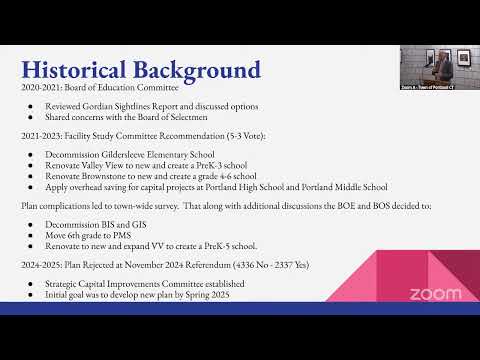
The recommendation grew out of a multi-year process that began with a 2020 facilities analysis by Gordian, followed by work from a facility-study committee and a strategic planning committee. Charles said the ed-specifications task force is proposing a renovate-to-new approach for Valley View and Gildersleeve because recent changes in state reimbursement rules — including a new 15% pre-K bonus and a potential Open Choice bonus if Portland reserves seats — substantially increase the portion of project costs covered by the state.
"If we get this across the finish line, Portland could get a $47.5 million school on a local property-tax base of about $14.2 million," Charles said, calling the new reimbursement bonuses "enormous" and adding that the town's current base rate is about 53.93% (rounded to 54%). He and the town's architect and staff said they had discussed the numbers with the Connecticut Department of Administrative Services (DAS) and received confirmation emails, but also cautioned that reimbursement incentives can change with state policy and elections.
Bryce, the project's architect from Fryer Architecture, described "renovate to new" as a process of gutting a building to its foundations and steel, updating HVAC, life-safety systems, accessibility, and energy performance, and using existing district capacity for swing space so portable classrooms are not needed. He said that approach meets DAS requirements for a facility expected to perform for 20–25 years and that Portland's current overcapacity would make swing space feasible during construction.
The task force's draft budget and sequencing call for renovating Valley View first (a two-year construction window), moving PK–2 and then grades 3–5 as schools are completed, and ultimately turning Brownstone over to town agencies after a five-year period in swing-space use. The presenters estimated overhead savings of roughly $875,000–$1,175,000 from consolidating three elementary schools to two and suggested redirecting those operating savings into capital to smooth mill-rate effects when bond debt service begins.
Supporters on the ed-specs task force argued that, after factoring state bonuses and the relatively small additional local ask for renovate-to-new versus a capital-improvements-only plan, renovate-to-new provides far more long-term value for a marginal incremental cost. Opponents pointed to the strategic planning committee's earlier recommendation for targeted capital projects at Gildersleeve to avoid demolition of roughly 9,000 square feet; task-force members said later state guidance and an ability to remove a canopy reduced that overage and improved the renovation option's economics.
Bob Shea, the district's facilities director (joining by phone), warned that capital projects spread over many years are administratively complex and can raise total costs because of repeated bidding and staged work. He emphasized urgency on roofs, HVAC systems and aging controls and said the district has already spent extra on contractors to keep systems running.
Resident Ben (identifying his address during public comment) asked for clarification of how special-education square footage would be counted for the 15% bonus and how that affects overall reimbursement. Staff said special-education bonuses apply only to eligible spaces under renovate-to-new and that the exact special-education square footage and bonus calculations still must be worked out with the architect and DAS.
Charles said next steps would include a Board of Education vote on the ed-specs plan (the board was scheduled to meet later that night), submission of a priority-list application to DAS by the June 30 deadline, and preparation of a bonding resolution drafted with attorney Matt Ritter of Shipman & Goodwin for the Board of Selectmen and a potential town meeting and referendum in the spring. He warned staff must observe the legally required silent period once a bonding question is on a ballot.
After questions and a brief public comment, the moderator moved to adjourn the special meeting; members voted in favor and the meeting was closed. The Board of Selectmen planned to meet after a short break.
Ending: The presentation left several technical details to be finalized — most notably the precise special-education square footage eligible for the state bonus and the district's bonding-amortization tables, which the presenters said would be available within days — and set an immediate calendar of applications to DAS and internal planning work before any referendum could be scheduled.