Get Full Government Meeting Transcripts, Videos, & Alerts Forever!
Get email alerts on the Transportation Infrastructure topic
No spam. Unsubscribe anytime.
TDOT details $76.6 million I‑40/SR‑53 interchange project, posts procurement schedule
Summary
TDOT Region 3 presented scope, schedule and procurement requirements for the I‑40 at State Route 53 (Gordonsville Exit 258) interchange improvement: total budget $76.6M, PE FY26, ROW FY28, construction FY30; LOI due April 27, questions due April 23; Phase 1 results expected May 22.
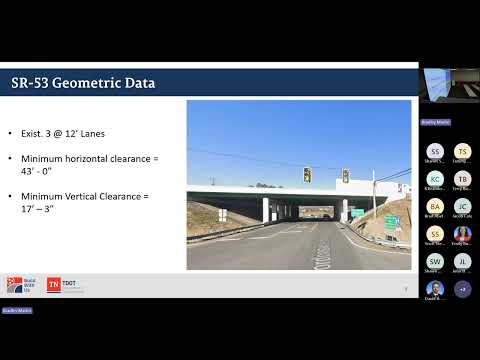
Bradley Martin, highway programs manager for TDOT Region 3, opened a mandatory pre‑proposal meeting for the Interstate 40 at State Route 53 interchange project in Smith County and said the goal is "to improve the interchange to reduce congestion and help with truck traffic." The project is located at the Gordonsville Exit 258 interchange and is in TDOT's 10‑year plan.
Martin summarized the budget and schedule: a $76,600,000 total program budget with $2,200,000 for preliminary engineering, $1,200,000 for right‑of‑way and utility engineering, and $73,200,000 for construction; preliminary engineering is scheduled for fiscal year 2026, right‑of‑way in FY2028 and construction in FY2030. John Story, Region 3 director of project management, said the project "is really important to us" and noted it had been advanced in the updated 10‑year plan.
TDOT outlined technical scope and firm responsibilities. Martin said field work will include survey, geotechnical studies and utility coordination and that the selected firm will be responsible for delivering QC‑checked work and managing project‑level tasks. "TDOT's not going to be the quality control for the selected firm," Martin said. The contract will use a cost‑plus‑fixed‑fee payment method and will include federal funding; proposers must use their federal overhead rate when billing.
Speakers from TDOT's environmental and technical teams described expectations for proposers. Sharon (environmental lead) said the environmental portion is intended to be turnkey and urged proposers to demonstrate an environmental team familiar with "the TDOT way," adding, "it's turnkey for a reason." Brandon (technical studies) told attendees that agency concurrences, such as U.S. Fish and Wildlife and SHPO, "will still have to come through our staff," and that proposers must QC the work of any subconsultants rather than relying on TDOT staff to perform that QC.
TDOT's professional services group, represented by Laura Doth, reviewed procurement milestones and submission rules: written questions are due April 23 by 4:00 p.m. Central Time; Letters of Interest (Phase 1) are due April 27 by 4:00 p.m. Central Time; Phase 1 selection notices are anticipated to go out May 22; requests for proposals and Phase 2 requirements will follow. The LOI should address three parts (firm overview, project fit and qualification type) and is expected to be brief (roughly 1–2 pages, excluding a cover sheet). Laura reminded firms that the LOI should list disciplines to be subbed rather than naming specific subconsultants.
TDOT also stressed compliance items that will affect review: Section E of the advertisement is limited to 20 pages, Section F to 10 projects, and the full proposal is limited to 40 pages (section H excluded); proposals exceeding page limits may not be reviewed. Attendees were directed to the project website (searchable as "Interstate 40 interchange at SR 53") and provided a QR code for project materials. Scott Stepp (Structures) said bridge inspection reports and existing bridge plans requested by attendees are available and can be provided to proposers.
On schedule, a TDOT representative online estimated that, after a concept is selected, approval of the IAR (the environmental document) could take about four to six months, placing potential approval around mid‑2027 depending on FHWA workload. Several attendees asked procurement and technical clarifying questions during a Q&A; Bradley said he expected fewer than 10 right‑of‑way tracts would be required based on the current budget and that relocations were not anticipated but could not be ruled out until design and budget are finalized.
Next steps: firms should submit questions to the TDOT advertisements mailbox (addressed to Natasha Whitfield if desired), submit LOIs by the stated deadline, and watch the professional services advertisements page for posted Q&A and phase selection notices. TDOT will post the meeting presentation and updated materials on the project website.
The meeting closed after a final reminder to sign the mandatory attendance sheet (required to submit an LOI) and to submit additional questions via the advertisements website.