Get Full Government Meeting Transcripts, Videos, & Alerts Forever!
Get email alerts on the School Construction topic
No spam. Unsubscribe anytime.
Anderson 5 board debates one-vs-two middle-school plan, funding choices and community outreach
Summary
At a work session the Anderson County School District 5 board discussed options to address enrollment and aging facilities at Robert Anderson and McCants middle schools, heard a proposed 800‑student site plan, reviewed a roughly $70–75 million cost estimate, and directed staff to prepare detailed financial scenarios and community outreach plans.
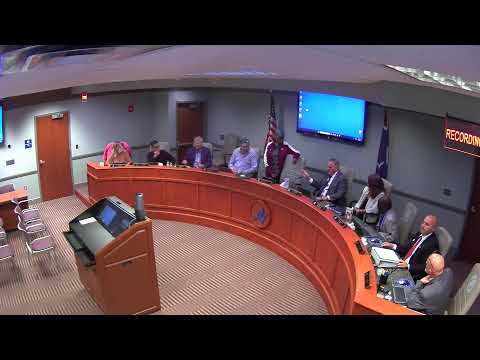
The Anderson County School District 5 board met in a work session to review options for its middle schools and to discuss how to pay for any new construction, the board Chair said.
Superintendent Dr. Kelly presented drawings for a proposed three‑story middle school sited adjacent to the district office that would hold about 800 students and include related‑arts space, a cafeteria, gym and an auditorium the presentation described as having an 800‑seat capacity that Westside High School could also use. Presenter Wes, introduced during the presentation, said stacking capacity for parent pick‑up and buses could be provided at both the front and rear of the site; the transcript records his estimate of stacking measured in the presentation as "20 2,000 feet" of linear stacking (transcript phrasing ambiguous).
Board members questioned how west‑side traffic would affect access to stacking and whether buses could be separated from parent pick‑up. "We could stack in the front," Wes said; a board member added that dismissal occurs roughly 3:20–3:40 p.m., so circulation timing is a key variable. The superintendent told the board those operational details would be studied further.
The meeting revisited options the board has previously considered: an on‑site sixth‑grade academy (already tried this year), adding a wing at Glenview, returning Southwood to a middle school assignment, or building one or two new middle schools. Several board members said the sixth‑grade academy has improved climate and outcomes in some measures but that community perception—shaped by social media and neighborhood impressions—continues to drive families away from Robert Anderson. "People still see that one school there," a board member said of the perception that Robert Anderson remains overcrowded despite district data that some members said show improvement.
Board members and staff discussed timing and cost. The superintendent noted the previously shared schedule of 14 months of design followed by a roughly 26‑month construction window. Cost estimates discussed in the meeting ranged from about $70 million to $75 million for a new school; the transcript includes a cited figure of roughly $72,000,000 as an estimate.
On financing, the board reviewed three broad paths: (1) continue transferring unspent general fund dollars into a capital projects account and let savings accumulate; (2) seek renewal of the countywide 1¢ sales tax in 2028 and use that revenue stream to pay down borrowing over time; or (3) place a bond referendum on the ballot to borrow in advance of those collections. Board members noted trade‑offs: a bond without the sales tax would raise local property taxes, whereas pairing a bond with the penny sales tax (as in prior referenda) could be presented to voters as not increasing the penny but instead using it to pay debt service.
The superintendent gave current fund balances the transcript records as a total of $87,874,398, broken out in discussion as about $31,702,143 in capital‑project funds and $56,172,255 in sales‑tax funds. The board also discussed roughly $150,000,000 of outstanding bonded debt from earlier referenda. Several members cautioned against depleting reserves and recommended keeping an 8% cushion (referred to in the meeting) for unexpected repairs and emergencies.
Multiple board members urged that the district not proceed without more community engagement. Members recommended additional public meetings, targeted outreach (churches, civic groups, business organizations) and better publicity about positive developments at Robert Anderson to change perception. One board member said the ballot will ultimately allow voters to decide tax questions and urged robust pre‑ballot education.
The board asked the superintendent and staff (named in the transcript as Dr. Kelly and Ms. Hurd) to "crunch the numbers" and return with concrete option sets that include cost estimates, reserve impacts, operating cost implications (for example, duplicated staff if a second middle school is opened), and discipline and climate data to compare schools. The board also referenced a demographic study completed in 2023 and discussed whether a new districtwide needs assessment or outside consultant should be engaged to survey parents and the community about perceptions and enrollment drivers.
The work session concluded with the board assigning staff homework to prepare financial scenarios and community‑engagement plans. A motion to adjourn was made and seconded; the chair called the vote and the meeting adjourned.
The board did not take any binding votes on construction or financing at the session; members directed staff to return with additional data and proposed next steps for outreach and decision timelines.