Get Full Government Meeting Transcripts, Videos, & Alerts Forever!
Get email alerts on the State Legislation topic
No spam. Unsubscribe anytime.
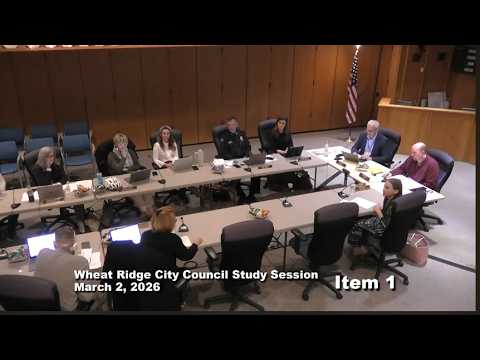
Wheat Ridge council hears Colorado Municipal League briefing on key 2026 bills that would limit local control
Summary
Bev Stable of the Colorado Municipal League briefed Wheat Ridge council on a slate of 2026 bills — from the HOME Act to minimum‑lot‑size and surveillance legislation — warning many would reduce local permitting authority and expressing CML opposition to several measures.
Bev Stable, legislative advocacy manager for the Colorado Municipal League, told the Wheat Ridge City Council at its March 2 study session that a number of bills before the state legislature could significantly limit local land‑use and public‑safety discretion.
Stable highlighted House Bill 101 (the HOME Act), which would let schools, nonprofits, public housing authorities and transit agencies develop residential property they own without following local permitting and zoning processes. "This allows entities to bypass a local government's existing permitting and zoning process," Stable said, adding CML is concerned the bill contains no affordability requirements tying new housing to demonstrated local need.
On housing and land use, Stable also flagged House Bill 1114, which would require jurisdictions in metropolitan planning organizations to allow single‑family lots as small as 2,000 square feet, or to eliminate single‑family zoning to avoid the requirement. Planning staff told the council Wheat Ridge’s smallest single‑family lots start at about 5,000 square feet. Stable said CML and many members oppose HB1114 and are tracking a separate "lot‑splitting" bill that could allow very small parcels by right.
Stable and councilors discussed infrastructure and service capacity concerns if zoning and lot‑size rules change. "There are some provisions ... specifically like water, wastewater," Stable said, "but infrastructure goes far beyond those types of considerations." Council members asked whether local guardrails would remain for roads, schools, parking and other services; Stable said the bills’ language may be narrowly defined and leave important local planning considerations out.
Public‑safety surveillance and data‑access bills were another major focus. Stable described Senate Bill 70 (often called the Flock or Pepys Act) and House Bill 1037 (referred to as the "Fourth Amendment is not for sale" bill). Wheat Ridge’s police chief told the council those bills, as drafted, could "hamstring" some investigative uses of location and historical data because of strict retention limits, warrant requirements and new private rights of action. "We could provide less public safety and fewer outcomes for our victims should this bill pass," the chief said, urging councilors to consider operational implications.
Stable also alerted council to other items of local interest: Senate Bill 98 (noise‑abatement clarity following Hobbs v. City of Salida), House Bill 1285 (seeking to codify distance limitations for transitional mental‑health living facilities), House Bill 1202 (a permissive special‑district approach to fund homelessness strategies), and a package of bills addressing data centers that split environmental and industry supporters. She described HB1202 as a locally controlled option to create a tax dedicated to homelessness prevention if voters approve.
On the massage‑parlor licensing issue, Stable said CML supports a bill to roll back elements of last year’s law that limited local licensing tools and capped fees. "We want to make sure there's not this ceiling for local governments when they're trying to regulate these facilities," she said, noting the cost of thorough background checks and licensure compliance can be high for municipalities.
Stable urged councilors and staff to consider submitting testimony (written or oral) and offered to circulate guidance for submitting testimony to legislative committees. She said several of the bills were in early committee stages and that CML would continue to refine positions and pursue amendments where possible.
The council discussed possible responses, including legislative advocacy through the city’s legislative committee and legal remedies if state preemption erodes local authority. Stable suggested litigation could be an avenue if local funds or authorities were demonstrably harmed, but emphasized that many items were still moving through committee.
The council did not take formal action at the study session. Staff said they will monitor the bills, coordinate with the city’s legislative committee and report back as hearings and amendments develop.