Get Full Government Meeting Transcripts, Videos, & Alerts Forever!
Get email alerts on the Dementia Respite topic
No spam. Unsubscribe anytime.
Webinar spotlights Respite for All volunteer dementia‑respite model; Orange County adapts it for public settings
Summary
Daphne Johnston of Respite for All and Allison Smith of the Orange County Department on Aging described a volunteer‑led, social (nonmedical) respite model supported by the Administration for Community Living; speakers detailed training, logistics, seed grants, and how the model was adapted to a secular, civic setting.
Daphne Johnston, executive director and cofounder of the Respite for All Foundation, and Allison Smith, social engagement program coordinator at the Orange County Department on Aging, outlined during an Administration for Community Living‑supported webinar how a faith‑based, volunteer respite model is being adapted for public, secular settings to give caregivers regular, affordable relief.
Johnston described Respite for All as a social, volunteer‑centered model that emphasizes relationship building and a label‑free environment. She said the foundation has grown the model to roughly 60 locations across 18 states and reported a 92% sustainability rate over 13 years; the foundation offers seed grants of about $5,000–$10,000 and a road‑map training package. "We're all living with something," Johnston said, summarizing the program's label‑free approach.
Allison Smith said Orange County adapted the model into a program called Our Place, run from senior‑center sites and operating one day per week. She described the county's prior funding through a 2015 Administration for Community Living grant for the OC Cares project — characterized in the webinar as a three‑year, $900,000 commitment under the Alzheimer's Disease Initiative Specialized Support Services — and said that experience helped sustain staff and services that made adoption possible. "We started our place at 10 participants and 15 volunteers," Smith said; by the end of the first year the program expanded to 16 participants and 32 volunteers.
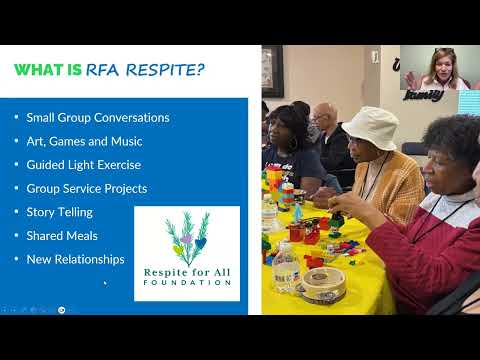
Both presenters emphasized that the Respite for All model is social rather than medical: activities are short, purpose driven, and designed to foster new relationships among participants. Johnston said the typical operating window is 10 a.m. to 2 p.m., with small‑group conversations, art, music and shared meals; volunteers receive about three hours of relationship‑focused training and use short instructional videos and hands‑on practice in the onboarding process.
On costs and access, Johnston said the model is generally tuition‑based to help long‑term sustainability, with program fees in examples ranging from about $20–$50 per day, but she and Smith said directors make spots available for people who cannot pay. "If that family says they cannot pay, they can attend," Johnston said. Smith added that her program used suggested donations initially and is transitioning toward a fee model to cover meals and other direct costs while ensuring no one is turned away.
Speakers also described operational adaptations for civic settings: secular programming (pop music, crafts with saleable purpose), recruiting volunteers with professional backgrounds (occupational therapists, pharmacists, retired clinicians) and negotiating shared space at senior centers that host other activities like fitness and pickleball. Smith noted practical constraints — setup time before the session, cleanup for subsequent activities, and the need for a larger volunteer pool for physical setup and teardown.
In the webinar Q&A, Johnston explained "vision calls" — 30‑minute planning conversations for local vision teams — and listed early steps for local organizers (check state regulations, identify host sites that can provide umbrella insurance, map food and staffing plans). Both presenters recommended using the Respite for All road map and the foundation’s monthly director calls and 1‑on‑1 coaching to troubleshoot operations.
The webinar concluded with a request for participants to register for a follow‑up session and contact information for questions. The Administration for Community Living supported the webinar series; organizers posted slides and a recording and offered additional materials for purchase online.