Get Full Government Meeting Transcripts, Videos, & Alerts Forever!
Get email alerts on the Copyright Policy topic
No spam. Unsubscribe anytime.
U.S. Copyright Office webinar debunks common myths on copyright, AI and registration
Summary
In a recorded webinar, attorney advisers from the U.S. Copyright Office explained core copyright concepts, corrected misconceptions about fair use, works made for hire, and duration, and answered audience questions on AI‑created works, publication online, and registration options.
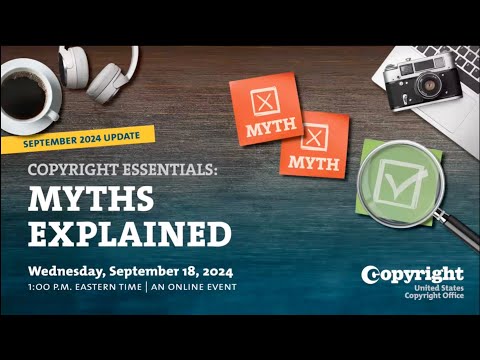
The United States Copyright Office hosted a recorded webinar titled “Copyright Essentials, Myths Explained,” in which agency attorneys outlined core copyright rules, debunked widespread misconceptions and identified resources for creators and organizations.
In a session framed as “fact or fiction,” Deputy Director George Serani introduced attorney advisers Laura Kaiser and Jessica Chinedorei, who explained that copyright law (Title 17 of the U.S. Code) protects original works of authorship that are fixed in a tangible form and set out the office’s duties, including maintaining public records and advising Congress.
Why it matters: The presenters said common misunderstandings can lead creators and organizations to misapply copyright protections, miss opportunities to register works, or mistakenly assume online content is free to reuse. The office highlighted tools—its online public catalog, the pilot Copyright Public Records System (CPRS), circulars and tutorial videos—to help users research rights and registrations.
Key takeaways
- What copyright protects: Jessica Chinedorei, an attorney adviser, summarized the statutory basics: copyright covers original works fixed in a tangible medium; fixation, originality and authorship are threshold requirements.
- Business names and inventions: Laura Kaiser said business names, slogans or inventions are not protected by copyright; trademarks or patents may apply instead.
- Works made for hire and ownership: The presenters stressed that paying for a work does not automatically transfer copyright. "To be an owner, you need to be the author," Kaiser said, and described the two categories of works‑for‑hire—employee creations and specially commissioned works meeting statutory criteria and a signed written agreement (Circular 30 provides guidance).
- Exclusive rights and enforcement: The office framed copyright as a “bundle” of six exclusive rights (including reproduction, derivative works, distribution and certain public performance/display rights). Laura Kaiser noted that copyright infringement is a legal claim, distinct from plagiarism, which is an ethical issue.
- Fair use is factual, not numerical: "Fair use is decided by a court or by the Copyright Claims Board on a case‑by‑case basis," Kaiser said, rejecting the idea that short clips (for example, six seconds) are automatically fair use.
- Registration benefits, fees and timelines: Registration is optional but recommended because it creates public records, eases licensing, and enables enforcement. The office described common fees (single‑work online filings beginning at $45; group options ranging about $55–$95; most inexpensive paper filing beginning at $125) and average processing times (about 1.2 months for an online application with no correspondence; longer if the office must communicate with the filer; paper filings typically take longer—about 4.1 months when no correspondence is required).
- AI and human authorship: Jessica Chinedorei said the office currently treats copyright protection as dependent on human authorship: material created solely by generative AI is likely to be refused registration, while works that include human authorship may be registrable but require disclosure. She noted the office issued a notice of inquiry in August 2023, received over 10,000 public comments, and published part 1 of a report on digital replicas on July 31 (the webinar did not specify a year for that July 31 date).
Questions from attendees
During a moderated Q&A, speakers addressed audience questions about online publication (the office has an open rulemaking and points to the Compendium of Office Practices for current guidance), the meaning of fixation (the work must be recorded or written so it can be perceived), fair use for nonprofit uses (courts weigh the statutory factors case by case and nonprofit status can be one consideration), and whether federal government works are copyrighted (works created by federal employees in the scope of employment generally are not protected by copyright). They also confirmed that minors can own and register copyrights, but registrations are public records.
Resources and next steps
Presenters pointed listeners to copyright.gov for circulars (including Circulars 2 and 30), the online public catalog and CPRS pilot, tutorial videos, the CCB handbook, the office’s AI page (copyright.gov/ai) and outreach services such as walk‑through appointments for registration help. The webinar was recorded and the hosts said links and resources were posted in the chat.
The Copyright Office did not propose new regulations during the session; it described existing guidance, ongoing rulemaking on publication, and continuing work on AI topics. The office encouraged attendees to use the cited resources and contact its Public Information and Education Office for additional assistance or to request a speaker.