Get Full Government Meeting Transcripts, Videos, & Alerts Forever!
Get email alerts on the National Debt Overview topic
No spam. Unsubscribe anytime.
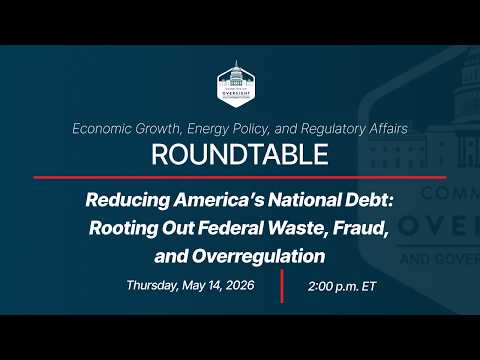
Experts tell House subcommittee rising interest costs and health‑care spending make U.S. debt trajectory unsustainable
Summary
At a House Oversight and Reform subcommittee roundtable, economists and fiscal experts warned rising net interest payments and health‑care growth are squeezing the budget; witnesses urged targeted anti‑fraud steps, regulatory budgeting and clearer metrics to show how federal debt raises household borrowing costs.
Chairman Burleson opened the subcommittee roundtable by warning that the United States’ fiscal trajectory is unsustainable, saying the nation’s explicit obligations are roughly $39 trillion and implicit liabilities tied to Social Security and Medicare push long‑term obligations far higher. He told the panel the cost of servicing federal debt is growing and now competes with spending for defense and households.
The roundtable assembled five experts to explain drivers of deficits and suggest policy responses. Bill Beach of the Fiscal Lab on Capitol Hill said mandatory programs and rising net interest payments are the chief contributors, and he urged the committee to pursue targeted reforms and better data to find waste. "Mandatory programs are growing two‑and‑a‑half times faster than other outlays," Beach said, arguing small, specific changes can signal markets that Congress is serious about fiscal discipline.
Dr. Rao (testifying expert) emphasized the scale of interest costs: net interest outlays reached $970 billion in 2025 and could absorb a growing share of non‑Social Security revenues in coming decades under current law. He recommended strengthening Medicaid anti‑fraud incentives, asking the Census Bureau for fuller income measures, conditioning municipal tax privileges on pension standards, and directing CBO or GAO to publish a dashboard that links federal debt to household borrowing costs.
Other witnesses agreed health‑care costs — Medicaid, Medicare and employer‑subsidized insurance — are the single fastest‑growing portion of federal spending and a central place to target savings. Doug Holds Aiken urged regulatory budgeting and structural reforms to slow growth in entitlement costs. Mike Konsel criticized recent tax legislation (referred to repeatedly in the session as the "1 Big Beautiful Bill" or OB3), saying it worsened the revenue outlook and highlighted the need to close the tax gap by improving IRS enforcement of high‑income avoidance.
The discussion ranged from technical questions about the relevance of a debt‑to‑GDP threshold to practical concerns about the debt ceiling and market risks. Panelists did not announce any formal committee actions; instead they urged a combination of short‑term steps to reduce waste and longer‑term reforms to entitlement growth and tax policy. The subcommittee gave particular attention to the Social Security trust fund timeline: witnesses said the trust fund is on track toward exhaustion around 2032 absent legislative action, risking a roughly 25% across‑the‑board benefit cut unless Congress acts.
The roundtable will inform the subcommittee’s oversight work on waste, fraud, regulatory budgeting and potential legislative options. The hearing included exchanges among committee members and experts but produced no votes or motions.