Get Full Government Meeting Transcripts, Videos, & Alerts Forever!
Get email alerts on the State Budget topic
No spam. Unsubscribe anytime.
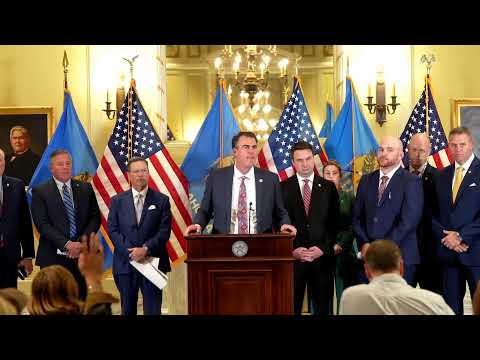
Governor Stitt and legislative leaders announce early FY27 budget deal, outline education, Medicaid and pension moves
Summary
Governor Stitt, Pro Tem Paxton and Speaker Hilbert unveiled a budget agreement they say preserves savings, funds education and creates a $200 million "taxpayer endowment trust," while planning a voter state question to move Medicaid expansion from the constitution to statute.
Governor Stitt and top Republican legislative leaders announced an early fiscal-year 2027 budget agreement on April 1, saying it preserves record savings while advancing tax cuts, education pay increases and policy changes to Medicaid.
"We have a budget deal," Stitt said at the press briefing. He framed the package as the product of eight years of fiscal discipline, saying the state built "the largest savings account in state history" and that the rainy-day fund peaked at about $5.5 billion.
Stitt said the package includes a plan to seed a taxpayer endowment trust with $200 million from existing savings and legislate dedicated funding sources intended to grow that trust to more than $1 billion over time so it can start delivering earnings to support general revenue.
Pro Tem Paxton described the budget as addressing an "expense problem," not a revenue shortfall, and said Republican leaders will put a state question before voters to move Medicaid expansion from the state constitution into statute. "When you come to Medicaid expenditures ... if we do not change our state constitution and move Medicaid expansion into our statutes, future legislatures will have no choice but to cut provider rates," Paxton said, arguing the change would allow the Legislature to adjust program rules and provider rates.
Speaker Hilbert praised the negotiation process and the early public posting of the proposal, saying the state is entering FY27 in a strong financial position with several years of above-estimate revenues and increased investments in public education.
On spending totals, legislative leaders described the top-tier budget as about $12.1 billion, with total spending cited in the briefing at roughly $12.786 billion — a 1.27% increase from the prior year. The leaders said the budget reflects an effort to limit one-time items and to back out one-time expenditures where appropriate.
Education was a headline focus: officials said the plan includes increased funding intended, in part, to boost starting teacher pay. "It's a proposed $2,000 teacher pay increase for the starting teacher salary," a presenter said, adding the change aims to move Oklahoma closer to the regional average. Officials emphasized that local school boards — not the Legislature — set district support-staff pay and local boards will decide how to allocate additional school-level funds.
Reporters pressed officials on Medicaid funding levels and program changes. The briefing identified a difference between agency requests and the additional legislative allocation (a roughly $494 million agency request vs. a $250 million addition in the proposed budget); officials said that gap could lead to program trade-offs such as reducing adult dental coverage or lowering provider rates. Stitt and legislative leaders said managed care has slowed some growth but that rising enrollment and federal funding shifts mean the state must consider reforms.
Officials also described targeted agency adjustments rather than across-the-board cuts. The appropriations leadership said most agencies started from a zero-net baseline and that negative deltas shown on some agency lines reflect backing out one-time items. They cited an approximately $64 million sweep involving "OTC" funding and a decision to reduce the government's pension match to OPERS by 7% (a cut smaller than an initially identified 9.23% option), which leadership characterized as intended to be net neutral to the pension's funding status.
No formal votes were taken at the briefing; leaders presented the negotiated package and said the budget text is posted publicly on the House website. Officials said they will continue to answer questions and expect the state question on Medicaid to appear on a future ballot so voters can decide whether to permit statutory adjustments.
Next steps included continued legislative processing and public review of the posted budget; leaders asked reporters and members to review details on the House website and noted appropriators remain available for follow-up questions.