Get Full Government Meeting Transcripts, Videos, & Alerts Forever!
Get email alerts on the Crime Data Measures topic
No spam. Unsubscribe anytime.
Bureau of Justice Statistics outlines how NIBRS and NCVS measure crime and highlights 2022 findings
Summary
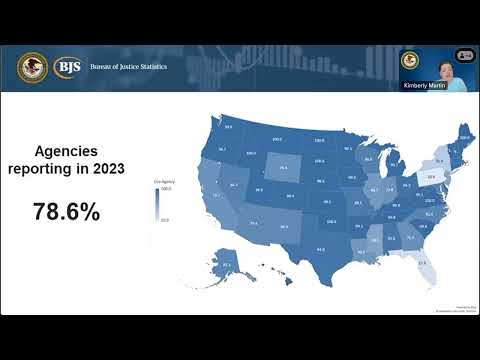
BJS statisticians explained how the National Incident-Based Reporting System (NIBRS) and the National Crime Victimization Survey (NCVS) complement each other, reviewed NIBRS’s expanded offense detail and coverage (78.6% agency participation; ~84% population coverage in 2023), and summarized NCVS 2022 findings including a 23.5 violent-victimization rate per 1,000 persons.
Bureau of Justice Statistics statisticians on Tuesday explained that the nation’s two principal crime measures — the FBI-administered National Incident-Based Reporting System and the Census-administered National Crime Victimization Survey — serve different but complementary purposes and should be used together when possible. "They complement each other," said Kimberly Martin, a statistician in BJS’s Law Enforcement Incident-Based Statistics unit, summarizing the webinar’s opening point.
Martin described NIBRS as incident-based administrative data reported by law enforcement agencies to the FBI and emphasized its growing coverage after a multi‑decade transition from the older Summary Reporting System. "As of 2023…78.6% of all law enforcement agencies are participating," Martin said, and she added that the 2023 NIBRS files will cover about "84% of the U.S. population" once the FBI releases them. Martin cautioned that NIBRS records can show required fields as unknown and that some quality problems do not trigger automatic errors, so analysts must account for warnings and local reporting practices when using the data.
Susanna Tapp, who leads BJS work on the NCVS, explained the survey’s role as the primary national source for crimes both reported and not reported to police. "The NCVS is the nation's primary source of information on criminal victimization," Tapp said, noting that the NCVS is a household panel survey administered by the Census Bureau to people age 12 and older. She summarized 2022 NCVS results: "In 2022, there were 23.5 violent victimizations per 1,000 persons aged 12 or older in the United States," and about 6.6 million victimizations were measured for that year.
Presenters walked through important differences users should keep in mind when comparing measures. NIBRS collects detailed incident and arrestee information and breaks offenses into 71 Group A categories (with a separate Group B arrest-only list); it also allows analyses of multi‑victim incidents and incident‑level linkages to clearances or arrests. The NCVS, by contrast, captures victimizations that never reach police and collects consequence and service‑usage information from respondents (for example, mental‑health impacts and use of victim services), making it the better source for estimating the share of crimes reported to police.
The presenters used example dashboards and tools to demonstrate access paths and simple analyses: LEARcat (BJS’s law‑enforcement reported crime analysis tool), BJS NIBRS extract files hosted at the National Archive of Criminal Justice Data, the FBI Crime Data Explorer (CDE) and API, and NCVS dashboards and public‑use files. Martin highlighted that BJS provides concatenated extract files to make cross‑segment analysis easier: "BJS has done the work for you," she said, describing victim and offender extract files that join the relevant segments into flat files.
The session included topic‑specific findings that leverage NIBRS and NCVS differences. Martin said NIBRS national estimates showed roughly 2,400 victims of human trafficking for commercial sexual acts in 2022 and about 600 victims of human trafficking for involuntary servitude, with children accounting for about 36% of commercial‑sex victims. Tapp added NCVS context on reporting: in 2022 roughly 40% of violent victimizations were reported to police, and firearm involvement rose from 7% of violent victimizations in 2021 to about 10% in 2022.
In a Q&A segment, presenters addressed data correctness and training: agencies typically certify NIBRS submissions after purchasing NIBRS‑compliant records management systems, run certification submissions that must correct flagged errors, and receive continuing training from state UCR programs and the FBI. On geographic detail, Tapp said NCVS restricted files managed by the Census Bureau can include household location down to substate geography for approved researchers, while Martin said NIBRS provides the reporting agency and highly specific location types (over 50 categories) but does not include precise public lat/long or street addresses in standard submissions.
The webinar closed with contact information and resources; presenters asked users with detailed questions to email AskBJS@usdoj.gov. The session emphasized that neither system is "right" or "wrong" — each answers different questions and together they can provide a fuller picture of crime in the United States.