Get Full Government Meeting Transcripts, Videos, & Alerts Forever!
Get email alerts on the Home Rule Charter topic
No spam. Unsubscribe anytime.
Willow Park commission outlines home‑rule charter; residents challenge ethics board language and petition rules
Summary
At a town hall, the Willow Park Home Rule Charter Commission presented a draft charter proposing six council seats, three‑year terms and stronger citizen tools. Residents pressed the commission on an ethics board, subpoena language, petition signature thresholds and election timing.
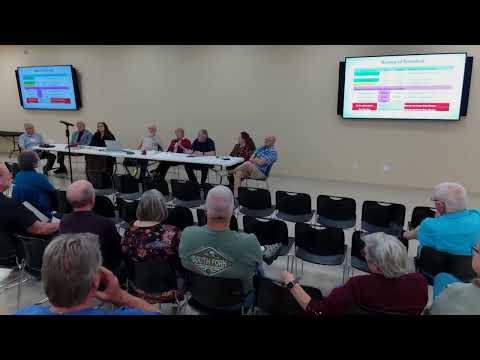
Willow Park’s Home Rule Charter Commission laid out a draft charter at a packed town hall Thursday, proposing to expand the city council from five to six members, move council terms from two to three years, give the mayor a vote and add citizen tools such as initiative, referendum and recall.
The proposed charter would preserve existing powers granted by state general law while creating new mechanisms for voters to shape city government, the commission said. The commission emphasized it would submit a final draft to the city council by Jan. 27 so the city could meet the deadline to call a May election.
Commission members said the changes are intended to increase continuity and citizen access. "For a new council member, that first year ... is a learning experience," a commissioner said, arguing three‑year terms give members time to complete a budget cycle and be effective. The commission also said the mayor would be an equal voting member and that the charter would require the city to publish the evaluation criteria used for the city manager.
Residents pressed the commission on several contentious provisions. One attendee warned the ethics board language would hand excessive power to an unelected panel, calling it "like a homeowners association gone crazy." The commission responded that the most controversial language had been pared back after legal review and that full subpoena authority language in articles 11 and 12 had been removed from the draft. "I don't believe there is a subpoena power anywhere else in the document," a commission member said.
The town hall also focused on how citizen petitions would work. The draft uses the lesser of two measures to trigger an initiative or referendum: 30% of votes cast in the most recent general election or 10% of current registered voters. With roughly 4,500 registered voters in Willow Park, the commission noted, 10% would be about 450 signatures while 30% of the last turnout (751 votes) would be about 225. A commission member said verification of petition signatures follows state law and typically uses the county voter database to confirm names and addresses.
Residents questioned the timing of a charter election, asking why the commission seeks a May vote instead of waiting for a November contest that typically draws higher turnout. Commissioners said placing the measure in May aligns with the city’s election cycle and that the charter could be overshadowed on a county, state or federal November ballot.
Other points raised at the meeting included whether the charter would change bond procedures; a commissioner confirmed that general obligation bonds would require voter approval under a bond ordinance and said the draft does not fully differentiate bond types. The commission also estimated the largest direct cost of adopting the charter would be mailing the full draft to every registered voter; one budget estimate shown at the meeting put printing and mailing at roughly $12,000–$14,000 depending on paper and postage choices.
What happens next: the commission said it would incorporate about 60 changes discussed in recent meetings, repost the updated draft to the city website, hold additional town halls and deliver the final draft to the city council on Jan. 27. The city council, not the commission, will call the election and arrange ballot language and logistics. "When we complete this, finalize it, we turn it over to the city council," the presenter said.
Speakers quoted and referenced in this report are drawn from the meeting transcript, including commission secretary Tandy Blacktock and former judge and commission member Roy Gervin. Several residents spoke during a public‑comment period and raised the ethics, petition and timing concerns summarized above.