Get Full Government Meeting Transcripts, Videos, & Alerts Forever!
Get email alerts on the Historic Preservation topic
No spam. Unsubscribe anytime.
Presenter Steve Warop traces Darlington's Corners history as Westtown plans to buy Darlington Inn
Summary
At a local presentation, Steve Warop surveyed the history of Darlington's Corners — its inns, factories, markets, transportation plans and notable crimes — and said the township is acquiring the Darlington Inn, prompting discussion of preservation and the potential impact of PennDOT roadwork.
Steve Warop, a presenter at a community historical talk, outlined the layered history of Darlington's Corners and said Westtown Township is preparing to acquire the Darlington Inn building on the corner of Route 202 and Street Road.
Warop opened by warning that local records are scattered and sometimes contradictory and that his account is an amateur survey of the place commonly called "Darlington's Corners." "Today we're going to be talking about Darlington's Corners," he said, and then traced how maps, local tradition and federal records do not always agree on the village name or municipal boundaries.
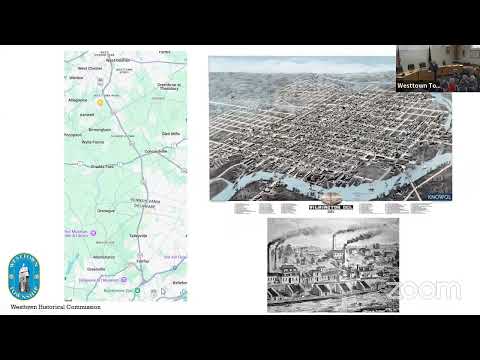
The presentation connected transportation and industry to the crossroads' growth. Warop said Wilmington's role as a major port and the presence of the DuPont gunpowder works drove demand for a roadway between Westchester and Wilmington; that early Wilmington Road later became Wilmington Pike, and the corner developed as a regular stopping place for travelers and drovers. "In those days that was a very long ride and you needed a place to stop," he said.
Warop described early local manufacturing: an 1820 weaving factory associated with the Darlington family (records listed 11 men, five women and five children and an annual payroll of $3,120), local inventors who brought or adapted devices such as an early washing machine, and a locally patented corn cultivator credited to Joseph Britain around 1880. He said many of those enterprises collapsed or contracted after the financial panic of 1873, which also derailed proposed rail and trolley links to the crossroads.
The presenter reviewed everyday life at the corner: inns and taverns that served travelers and their livestock (including pens behind inns), a longstanding pattern of corner markets (the site now hosting a CVS, gas station and an Amish market), and trades such as blacksmiths and wheelwrights that serviced agricultural and transport needs. He noted distinctive local materials — a serpentine quarry produced greenstone used in several buildings — and described an 1891 blacksmith/forge cluster and an early reported burglary of a blacksmith shop.
Warop recounted darker episodes from local newspaper archives, including accounts of a woman described in contemporary reports as mentally ill who attacked people at Darlington and the widely reported, unsolved killings in 1900 of members of the Sharpless family and of Sarah Morrison. He summarized how contemporary reports offered conflicting witness accounts (reports of "suspicious tramps," later arrests, and no conclusive proof) and emphasized that these remain unsolved in the historical record.
On the corner's landmark building, Warop said the structure now commonly called the Darlington Inn began as a log-cabin tavern, later bore names including the Darlington Tavern and Westtown Inn, lost a liquor license at one point, and was turned into a private residence in 1908. He said the township is in the process of acquiring the property and that the building could be used for a variety of community purposes: "I've heard people talk about everything from restaurants to a local history center," he said, and urged residents to share ideas with the township supervisor and commission.
Warop also flagged an engineering study and pending road work on Route 202 by PennDOT that proposes turning lanes and could require additional land near the corner; he said the study's author reported that the building should be safe but noted local concern about the potential impact.
The presentation closed with a request that residents provide input to the township about future uses and with the historical commission's stated intent to preserve memory and, where feasible, fabric. "That's why we're here," Warop said. "Your ideas should be given to that supervisor and his other members of the board."