Get Full Government Meeting Transcripts, Videos, & Alerts Forever!
Get email alerts on the Well Permits topic
No spam. Unsubscribe anytime.
Santa Monica Basin GSA approves standardized email responses for well‑permit applicants
Summary
The Santa Monica Basin Groundwater Sustainability Agency on April 15 approved a set of standardized email templates to respond to well‑permit inquiries from applicants, clarifying procedures for production wells inside the basin, monitoring wells, out‑of‑basin wells and well destructions and warning that failure to provide requested information may delay a GSA non‑objection letter.
The Santa Monica Basin Groundwater Sustainability Agency approved standardized email responses for different well‑permit scenarios at its April 15 meeting, aiming to streamline coordination after Los Angeles County revised its well‑permit application form to ask applicants to contact the GSA.
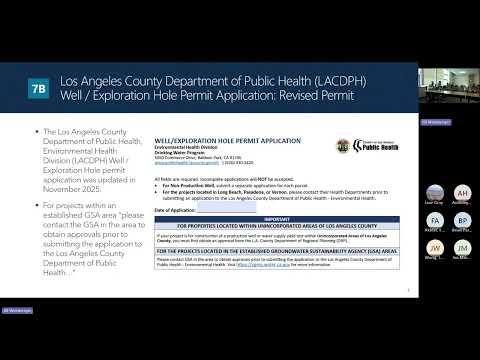
Staff told the board that LA County’s new application (issued November 2025) explicitly asks applicants for projects within GSA areas to contact the agency before submitting. In response, the SMBGSA proposed three (later expanded to four/five) template replies: one requesting detailed information and a commitment to install flow meters for production wells inside the Santa Monica subbasin; a short “no objection” response for monitoring‑well applications; a notification that a project is outside GSA boundaries (no objection); and a short template for well destruction/demolition filings. The production‑well template asks applicants to affirm they will “provide the requested information” and confirm installation of flow meters; staff said failure to provide the information could delay issuance of a GSA non‑objection letter.
Anthony Hickeyi, a hydrogeologist speaking for the Los Angeles Country Club’s driller, told the board the driller had just submitted an application and urged the GSA to include well‑destruction permits in its templates so demolition permits are handled consistently. “I am a hydrogeologist…working on behalf of the Los Angeles Country Club,” Hickeyi said, and asked how the process would affect timelines for the Country Club’s replacement well application.
Board members debated whether the agency should use the word “request” or the stronger “require” in the production‑well template. One director urged more mandatory language, saying that vague “request” terminology could be ignored by an applicant; other members counseled prudence, noting legal limits on the GSA’s authority and the risk of delaying county permit processing if the GSA held applications pending additional materials. Legal counsel advised that the GSA may require metering for wells capable of producing more than two acre‑feet per year and that the board should seek closed‑session legal advice about other enforcement authorities.
The board also discussed administrative process and Brown Act limits: staff proposed notifying individual board members by BCC e‑mail when applicants affirm they will provide information, and agenda‑izing any objections for a public meeting rather than using e‑mail exchanges to reach consensus. Counsel said BCC notification can be used for information as long as members do not attempt to build a consensus outside a public meeting.
After edits to the proposed language (including a sentence warning that failure to provide requested information may delay a non‑objection), directors moved, seconded and voted to approve the set of templates in open session. The motion carried. The GSA secretary will send the template replies to applicants and notify board members of affirmative responses; any formal objection will be brought to a future meeting.
The action does not change county permitting rules; staff said the templates are intended to document coordination so applicants can staple a GSA response to a County Public Health application as requested by county staff.
What happens next: staff will post procedures on the GSA website, incorporate minor edits agreed in the meeting into the template texts, and bring any unresolved legal‑authority questions to a future meeting or closed session with counsel.