Get Full Government Meeting Transcripts, Videos, & Alerts Forever!
Get email alerts on the Redistricting topic
No spam. Unsubscribe anytime.
Mayor asks for evidence of voting-rights violations as Felter warns reverting map would split historic neighborhoods
Summary
At a public briefing over ordinance 129-2025 (which repealed ordinance 37-2024), the mayor asked for factual proof of any Voting Rights Act or one-person-one-vote violations; Council Member Felter testified reverting to older lines would split the Garden District, City Park and South Alexandria and could leave some precinct voters without a council election for multiple cycles.
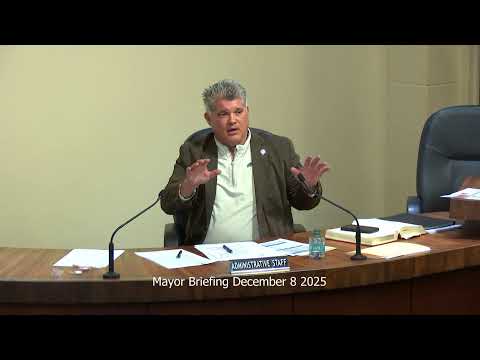
The mayor opened a public briefing on ordinance 129-2025 — adopted by the council in a 4-3 vote and reported to repeal ordinance 37-2024 — and asked anyone who alleges a Voting Rights Act or one-person-one-vote violation to provide evidence.
"If someone comes with the smoking gun, we will have it," the mayor said, adding that serious allegations require strong factual support: "bring the receipts." He said his first task was to determine whether the change denies access to the ballot or otherwise runs afoul of equal protection standards; if those thresholds are not met, he said, the result is a political question for the council.
Council attorney Mr. Guest told the briefing he had reviewed the plans and the materials available to the city and had not seen empirical evidence of a Voting Rights Act or one-person-one-vote violation. "Both plans meet the population requirements and the permissible deviations," he said.
Council Member Miss Felter gave extended testimony opposing the council’s move to revert to the earlier (2022) lines. She said the 2024 map — which she described as preserving precincts and neighborhood continuity — unified historic neighborhoods and avoided split precincts, while the 2022 lines would "slice through our city's oldest neighborhoods," naming the Garden District, City Park and South Alexandria. "The answer to both questions is yes. And I'm here to put the facts into record and explain why," she told the panel and the public.
Felter also argued reverting to the earlier map after an election would have practical electoral consequences for some voters because of staggered council cycles. She said the precinct at issue (C18) voted for her by a large margin in the most recent election and that moving that precinct into another district now would mean residents would not have another chance to vote for a council seat for multiple years under the staggered schedule; she characterized that effect as disenfranchising those voters.
The mayor and counsel addressed litigation that has been filed over the maps. The mayor said a federal suit that included a Voting Rights Act claim had been dismissed and that a state suit raising a charter compliance claim remained pending; he said deposition transcripts and dismissal documents would be placed in the council record. The mayor asked that any deposition or court filing that bears on a Voting Rights Act or one-person-one-vote allegation be supplied to the council for review.
The briefing included discussion of the technical role played by the Rapids Area Planning Commission (RAPC) and its executive director, Matt Johns, who provided census-tract and precinct data to map drafters. The mayor and two council members said they had spoken directly with Johns, who told them he had not been threatened despite public accusations that he had been.
The mayor left the record open and said the matter would continue the next day with a focus on neighborhood-level criteria — compactness, contiguity, precinct preservation and communities of interest — and that he would treat any credible evidence of a rights violation with the "degree of importance that it deserves."