Get Full Government Meeting Transcripts, Videos, & Alerts Forever!
Get email alerts on the Homelessness Funding topic
No spam. Unsubscribe anytime.
Arlington DHS outlines Continuum of Care operations as HUD funding fight clouds competitive grants
Summary
Arlington County Department of Human Services briefed a committee on its Continuum of Care, local program outcomes and mounting uncertainty over HUD’s CoC funding competition after policy changes and an ensuing court challenge, while warning staff are preparing for both non‑competitive renewals and possible 2026 competition rules.
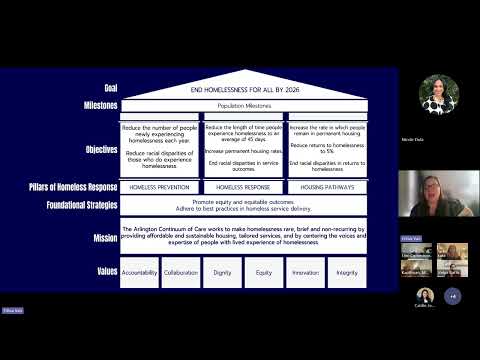
Trina, a Housing Assistance Bureau staffer at Arlington County Department of Human Services (DHS), told a county committee that the CoC — a HUD-designated framework for coordinating services — centers on coordinated entry, street outreach, emergency shelter and housing interventions. “Our goal is to make homelessness rare, brief, and non‑recurring by providing affordable and sustainable housing, tailored services, and by centering the voices and expertise of people with lived experience of homelessness,” Trina said.
Trina said DHS serves as the CoC lead and oversees the Homeless Management Information System (HMIS) used by nonprofits to track clients and services. She listed partner providers including Arlington Thrive, Bridges to Independence (family shelters and rapid rehousing), Doorways for Women and Families (domestic violence services) and Path Forward (single‑adult shelters, outreach and day programs).
The briefing reviewed recent performance: the CoC served more than 1,300 people across outreach, coordinated entry, shelter and permanent housing programs in FY2025, and a separate targeted prevention program served more than 1,600 households in that year. Trina underscored trends from the annual Point‑in‑Time count, saying pandemic-era declines have reversed and 2025 counts returned toward or above pre‑pandemic levels; the 2026 count was completed in early February and data were expected to be released later in the month.
A central focus of the presentation was federal funding. Trina explained that HUD’s 2025 CoC Notice of Funding Opportunity (NOFO) introduced significant policy and competition changes and has been the subject of litigation brought by several CoCs and the National Alliance to End Homelessness. “The 2025 competition is still in the courts,” Trina said, and she warned that Congressional fiscal deadlines have pushed HUD to renew some funds non‑competitively while preparing to meet statutory timelines. DHS staff are preparing for both short‑term non‑competitive renewals and the prospect that HUD will use the contested 2025 competition structure in 2026.
Trina said the CoC’s FY2026 funding portfolio is roughly $19 million, with a majority drawn from local county investments, about 40% from state sources and roughly 20% from HUD; she noted additional private and philanthropic funds raised by nonprofits are not included in that figure. She described how HUD priorities and funding structure shape local programming, particularly for permanent supportive housing.
Committee members asked how policy shifts could affect local capacity. Trina said changes that reduce renewal certainty or shift evaluation criteria could force program adjustments and that the CoC is watching both court and legislative developments. She urged committee members to use governance committees and the lived‑experience advisory council to help implement policy and program changes locally.
The briefing closed with staff describing local progress — sustained 'functional zero' for veterans since 2015 and efforts to approach similar milestones for transition‑age youth and people experiencing chronic homelessness — while emphasizing that federal policy uncertainty remains a material planning risk.