Get Full Government Meeting Transcripts, Videos, & Alerts Forever!
Get email alerts on the Grant Progress topic
No spam. Unsubscribe anytime.
Richmond Rising partners say $35 million program is halfway done; projects report design and outreach milestones
Summary
Partners reported that the Richmond Rising $35 million Transformative Climate Communities grant has reached its halfway point, with design milestones on neighborhood-complete-streets and the Wellness Trail, continued outreach for an e-bike lending library, and workforce and tree-planting activities underway.
Chair Malia opened the Collaborative Stakeholder Committee meeting on May 6, where partners provided mid-grant updates for the Richmond Rising initiative, which they said is funded through a $35 million Transformative Climate Communities award.
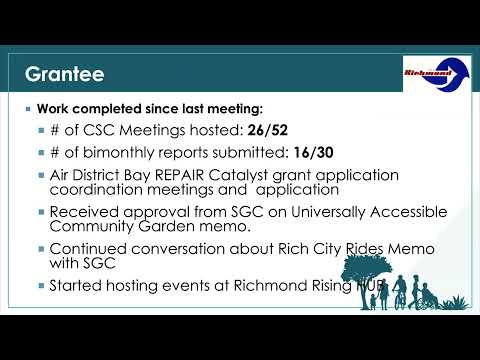
City representatives, speaking for the grantee, said the program has submitted invoice 16 of the required 30 bi-monthly reports and described the grant as “halfway” through its timeline. The city’s project lead said partners are coordinating an application to the Bay Area Air District’s catalyst grant programs to secure additional resources for air-quality and resilience projects.
Partners reported project-level milestones and budgets. The neighborhood complete-streets program is roughly 90% through design, staff said, and teams have met with Caltrans and a NEPA environmental review team because federal funds are involved. The city plans to issue a request for proposals for the second phase of construction once design approvals are finalized.
Presenters on the Richmond Wellness Trail said they completed lighting studies (wired versus solar), conducted warrant analyses for crosswalks and pedestrian refuges including Hall Avenue, and received a progress design set ahead of a multi-department all-hands meeting.
Mobility efforts reported included an e-bike lending library that conducted outreach at Cinco de Mayo, applied for a Union Pacific grant and intends to submit additional opportunity grants; staff said the program will present to city council as part of an effort to close a funding gap. Grid Alternatives reported two home solar installations (one interconnected), upcoming installation trainings for an October cohort, and ongoing canvassing and community workshops.
Environmental and food-access programs also reported progress: Groundwork Richmond said it planted 25 new trees at Nevin Park (with additional residential plantings) and planned replacements for trees vandalized at JFK Park; Orchard for All distributed roughly 148 fruit trees and graduated four apprentices from a six-week program; Veggie RX distributed 100 produce boxes and held climate-friendly diet workshops.
Partners acknowledged data and slide inaccuracies in the meeting deck and committed to updating budget and goals slides for the next meeting. UC Berkeley, which is developing a public dashboard to show TCC progress, said it will finalize its Year 2 report and coordinate a public release of the dashboard.
Why it matters: The committee provides advisory oversight for grant-funded projects affecting neighborhoods including the Iron Triangle, Santa Fe and Coronado. The mid-grant checks reported on design readiness, federal permitting steps, and staffing needed for workforce programs that feed into construction and installation work.
What’s next: Staff said they will prepare the RFP for the second phase of the complete-streets project, refine budget/goal slides for the next CSC meeting, and pursue the Air District catalyst grant application to secure additional funds. The committee approved past meeting minutes earlier in the session and will meet again next month to review updated slides and reports.