Get Full Government Meeting Transcripts, Videos, & Alerts Forever!
Get email alerts on the Stormwater Permitting topic
No spam. Unsubscribe anytime.
Titusville staff detail stormwater standards and AI‑assisted plan reviews; council probes design thresholds and maintenance responsibilities
Summary
Community Development explained Titusville's stormwater permitting rules (pre/post flow, timing, 24‑hour volume and freeboard) and reviewed an AI pilot (SwiftGV) that flagged checklist and code inconsistencies; councilors asked about 25‑ vs. 100‑year standards, maintenance obligations and next steps for code tweaks.
Community Development staff briefed the City Council on May 26 about local stormwater permitting standards and a separate effort to speed site‑plan reviews with AI assistance.
Kio Fosu described the city's approach: in addition to state and St. Johns River Water Management District requirements, Titusville requires applicants to demonstrate no increase in peak discharge rate, the same timing for peak flow, and no increase in 24‑hour runoff volume from pre‑ to post‑development. For certain sites that lack a legal positive outfall or where historic flooding exists, staff said the city requires analysis to a 100‑year/24‑hour storm (equivalent cited in the presentation as roughly 13 inches), while most sites that discharge to publicly maintained systems are governed by a 25‑year/24‑hour standard.
Fosu walked the council through storm‑event characterization, explaining return‑period (25‑year, 100‑year) and FEMA's recommended probability framing (for example, a 100‑year event equals a 1% annual chance). He used an October 26, 2025 storm — which some reports indicated produced 12–15 inches in places — to illustrate how different durations and datasets change the classification and why short‑duration, high‑intensity events require careful local consideration.
Staff reviewed typical post‑development controls (wet/dry ponds, control structures and weirs), freeboard requirements (minimum half‑foot for a 25‑year/24‑hour event), and the as‑built verification and permit‑closeout processes. Fosu noted the city uses standard engineering tools (hand calculations for simple projects, HydroCAD and StormWise/ICPR for complex routing and flood‑protection modeling) and enumerated the permit submittal requirements developers must provide (geotechnical reports, topographic surveys, nutrient loading and routing calculations).
Councilors pressed staff on whether the city should design more broadly for frequent short‑duration storms versus rare long‑duration events. Staff reiterated that the code uses 25‑year standards when a legal positive outfall exists, 100‑year when it does not or when upstream/downstream flooding is documented, and that the new state rules require applicants to submit maintenance plans and funding mechanisms for long‑term upkeep (often by property owners or HOAs).
On permitting process efficiency, Brad Parish summarized an AI pilot with SwiftGV that analyzed 200+ single‑family and multiple site plans. The AI flagged recurring omissions (sidewalk/driveway details, photo‑metric plans and cover‑sheet information) and identified technical inconsistencies between the code and technical manuals — particularly in landscaping requirements. Parish said the AI reduced review times in testing by roughly one‑third to one‑half for some stormwater reviews and that staff will return with recommended code tweaks, improved applicant checklists and an option for applicants to pay a pass‑through fee to cover AI review costs.
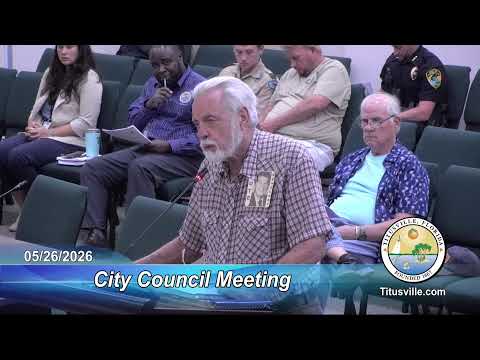
Members of the public used petitions and comment time to urge planning for short‑duration storms, to emphasize treating runoff before discharge into sensitive receiving waters and to call for better inspection and maintenance of outfalls; a resident and a local engineer raised concerns about several culverts/outfalls between Fox Lake Road and State Road 50, and staff agreed to forward maintenance concerns to the state when the infrastructure sits within state rights‑of‑way.
The council did not adopt code changes during the session; staff said they will prepare recommended technical-code amendments, improved checklists for applicants and follow up on inspection/maintenance concerns.