Get Full Government Meeting Transcripts, Videos, & Alerts Forever!
Get email alerts on the Comprehensive Plan topic
No spam. Unsubscribe anytime.
Robinson council debates $250,000 comprehensive plan update and possibility of a unified development ordinance
Summary
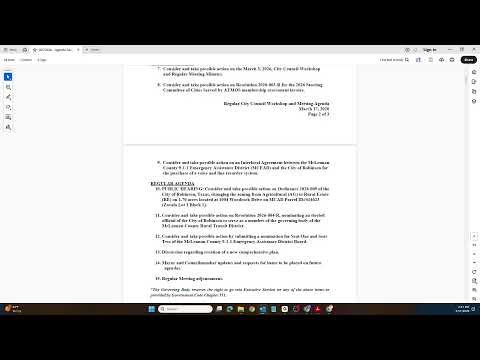
Robinson City Council discussed launching a comprehensive plan update estimated to take 12–18 months and cost up to $250,000. Councilmembers weighed combining a unified development ordinance (UDO) with the comp plan for savings and quicker code alignment versus risks of importing outside standards.
Robinson City Council members spent a large portion of the meeting evaluating whether to commission a new comprehensive plan and a possible unified development ordinance (UDO).
A staff presenter told the council the city’s comp plan update would typically take about a year to 18 months and could cost “as high as a quarter of a million dollars,” with potential state or federal grant reimbursements handled after the fact. The staff summary outlined a usual sequence: an RFP/RFQ to identify consultants, a council selection committee to evaluate responses, multiple public engagement sessions and advisory committee meetings, and a final draft returned to council for consideration.
Councilmembers debated whether to include a UDO — a consolidated package of zoning, subdivision and related development regulations — in the same contract. Supporters said combining the comp plan and UDO can produce economies of scale, streamline code changes to reflect the plan and improve grant eligibility for projects such as parks and transportation. One councilmember noted that pairing the UDO with the comp plan could reduce later retrofitting of ordinances.
Other members warned against simply copying another city’s regulations or adopting standards that do not fit Robinson’s context. Staff and council discussed sequencing alternatives, including using a consultant to evaluate the city’s existing ordinances first to scope the UDO work and limit cost. Council members also asked about procurement mechanics; staff explained the city commonly issues an RFQ (qualifications) and negotiates price with the selected firm rather than requiring fixed prices up front.
Supporters framed the comp plan as a tool to guide future decisions and to improve eligibility for grants and economic-development opportunities along Highway 77; skeptics asked about the plan’s return on investment and whether targeted updates to problem chapters might be sufficient. Staff said the current comp plan contains several sections that no longer match the city’s priorities and that building a clearer set of goals and actionable steps would help steer development and grant applications.
No formal action was taken; councilmembers requested staff return with procurement steps and potential scopes so the council can decide whether to proceed with an RFQ or separate the UDO into a later phase.