Get Full Government Meeting Transcripts, Videos, & Alerts Forever!
Get email alerts on the School Budget topic
No spam. Unsubscribe anytime.
Brookhaven-Comsewogue officials present $122 million expenditure budget, levy capped at 2%
Summary
District leaders presented a proposed 2026–27 expenditure budget of about $122 million and said the proposal uses the full 2% tax-levy cap (an estimated $168 average homeowner impact). Officials warned that state aid remains an estimate because New York State had not finalized its budget by April 1.
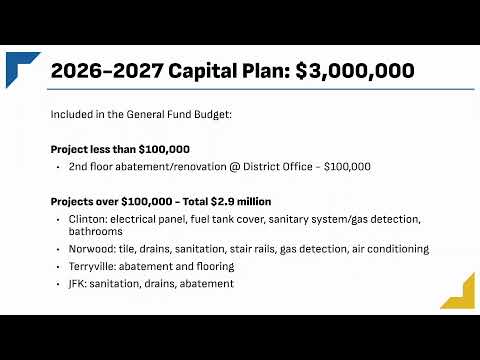
BROOKHAVEN-COMSEWOGUE UNION FREE SCHOOL DISTRICT officials presented the proposed 2026–27 expenditure budget at a public budget hearing, telling voters the plan relies on the full 2% tax-levy cap and would raise an estimated $3 million for capital transfers while preserving current programs.
"You don't vote on the revenue budget. You're voting just on this expenditure budget for $122 million," said Mrs. Cassali during the hearing, summarizing the item that will appear as Proposition One on the May 19 ballot. The presenters said the revenue figures are estimates and that the final state-aid number is not yet available because New York State had not adopted a state budget by the statutory April 1 deadline.
Why it matters: The proposed spending plan places nearly half of expenditures in payroll and benefits; presenters said personnel accounts for about 48% of the budget and employee benefits about 22%. Officials said these are largely fixed, contract-driven costs and are the primary drivers of the district's spending.
What's in the proposal: Presenters said the district's proposed expenditure budget includes: - A general fund expenditure proposal presented as approximately $122 million; the district materials provided the full line-item figures in the budget book available to the public. The exact printed total in the presentation materials was presented as an approximate number during the hearing. - Personnel (teachers, principals, aides) and employee benefits as the largest object categories (roughly 48% and 22%, respectively). - A $200,000 increase allocated to building security noted within the general-support category. - Increased capital transfers (presenters cited roughly $3 million available for capital projects) and a stated $2.5 million year-over-year increase in capital initiatives.
Revenue and uncertainty: On the revenue side, Mr. Dornichek said the district expects a roughly 5% increase in state aid compared with last year (presenters described this as about $2 million to $2.5 million), but cautioned this figure is an estimate because the state budget had not been adopted. An interjecting participant noted, "They were supposed to adopt a budget on April 1st. It's now May 6th and they still haven't adopted a budget," highlighting the timing risk. The presenters said the district is also planning to use an additional ~$1.4 million from reserves, expects about $200,000 more in interest income and projected modest changes in tuition, rentals and extended-day receipts.
Tax levy and homeowner impact: Presenters said balancing the expenditure proposal with projected non-tax revenues would require raising the tax levy by the allowable 2% limit. The district estimated an average homeowner impact of about $168 per year using the average assessed value cited in district materials.
Capital projects and program preservation: Officials outlined planned capital work across district buildings (smaller abatement and office renovation at Norwood plus larger projects at Clinton, Norwood, Terryville and JFK) and said some projects may require state approvals and could roll into the following year. Presenters emphasized that if voters approve the budget, the district intends to retain current programs, class sizes and extracurricular offerings.
Contingency scenario: Presenters warned that if the budget fails and the district moves to a contingency budget (no tax-levy increase), transfers to capital would stop, outside facilities could not use district buildings and staffing reductions or program reductions (including some athletic teams and specialized services) could follow.
Public materials and next steps: Budget books and required disclosures are available at each school, at the library and on the district website, presenters said. The budget will be on the ballot May 19; district staff listed Tim Donichuk, Mrs. Cassali and Dr. Quinn as contacts for questions.
The board closed the formal hearing and invited questions from attendees; a participant asked that the presentation be attached to the workshop agenda and posted to BoardDocs, and presenters confirmed the materials are on the district website and will be attached to the workshop agenda.