Get Full Government Meeting Transcripts, Videos, & Alerts Forever!
Get email alerts on the Curriculum Adoption topic
No spam. Unsubscribe anytime.
Board adopts OpenSciEd for high-school science in seven-year purchase
Summary
After cross-level committee scoring and classroom demos, the board approved a seven-year OpenSciEd adoption for high-school biology, chemistry and physics, authorizing up to $775,000 for the district-wide program and planning unit-by-unit teacher training next year.
The Tigard-Tualatin School District board on April 6 approved a seven-year adoption of OpenSciEd for high-school biology, chemistry and physics, authorizing staff to purchase materials and associated supports in an amount not to exceed $775,000.
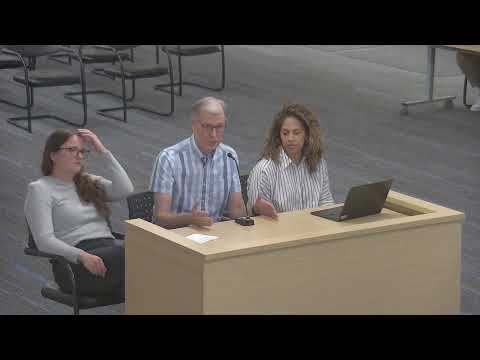
District curriculum leaders described a multi-month adoption process that used the Oregon Department of Educationinstructional-materials evaluation tool. Committees narrowed six candidate curricula to three publisher presentations, then to two finalists (HMH and OpenSciEd) after cross-school scoring and classroom demo lessons held February 26 at Tigard High School. Teachers piloted OpenSciEd lessons; teacher Amanda Cordes told the board she saw increased student engagement across levels and praised the curriculumfor data-rich student investigations and phenomenon-based storylines aligned to Next Generation Science Standards.
District staff said OpenSciEd is an open educational resource that can be adapted by teachers, does not require a proprietary learning platform, and has Spanish-translated materials available; the committee said it would support teachers with training and unit-by-unit coaching in year one and ongoing alignment work thereafter.
Director Weston moved the adoption and Director Himes seconded the motion; the board approved the purchase unanimously. Staff described next steps: professional learning for teachers before June, scope-and-sequence work by curriculum subcommittees next year, and continued district collaboration with neighboring districts using OpenSciEd for implementation lessons and training resources.
What this means in practice: OpenSciEd units center instruction around anchoring phenomena and student-driven driving-question boards, with investigations and data excursions designed to develop disciplinary core ideas, science practices and crosscutting concepts. The board recorded no dissent to the independent-adoption process and staff said they completed the ODE documentation required for non-ODE-pre-scored materials.