Get Full Government Meeting Transcripts, Videos, & Alerts Forever!
Get email alerts on the Copyright Public Records topic
No spam. Unsubscribe anytime.
U.S. Copyright Office demos new Copyright Public Record System pilot; officials outline features, limits and 2025 production plan
Summary
U.S. Copyright Office staff demonstrated the Copyright Public Record System (CPRS) pilot, which contains more historical indexing (over 2.9 million card-catalog records so far), highlighted search and export features, and told users CPRS will become the authoritative online catalog when it moves to full production in 2025 while some records and deposit inspections remain available only onsite.
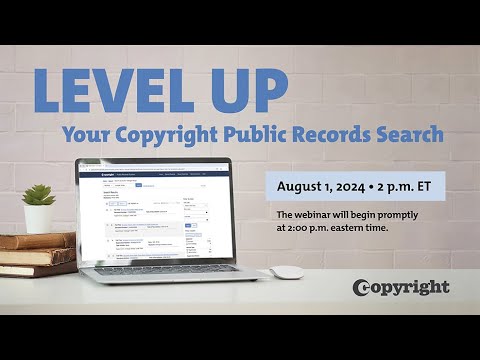
The U.S. Copyright Office on a webinar demonstrated its new Copyright Public Record System pilot, walked users through search and export tools, and answered questions about what records are available now and when CPRS will replace the current online public catalog.
Denise Wofford, Assistant Register and Director of the Office of Copyright Records, said the pilot “was first released as an open pilot in December of 2020, and the current plan is to move it into full production in 2025,” at which point CPRS will become the office’s sole authoritative online source for registrations and recorded documents submitted to the Copyright Office. Wofford also outlined long-standing limits of the current catalog — an outdated interface, strict formatting, a 10,000-result cap and incomplete pre‑1978 coverage — as drivers of the modernization effort.
The demonstration focused on practical search workflows in CPRS. George Thuronyi, Deputy Director in the Office of Public Information and Education, showed simple and advanced searches by author, title and date, and how filters and sorting can reduce broad results. Thuronyi illustrated finding a recent poem by Ada Limón, narrowing name results for “Vanessa Le,” and locating older works such as renewals for To Kill a Mockingbird.
Shawn Gallagher, the CPRS product owner, described the search engine behavior and options: “The default selection is going to be as a phrase,” he said, adding that users can choose Starts With or Exact depending on how narrowly they want to match an indexed field. Gallagher said CPRS already exposes more historical indexing — including card-catalog records from earlier periods — and provides a separate name directory and hyperlinked registration numbers to help trace related records.
Michael Goldfine of the Records, Research, and Certification Division (RRC) reviewed offline holdings and fee services: the card catalog contains about 45 million cards covering roughly 1870–1977, microfilm holdings and record books that remain primarily onsite in the Copyright Reading Room (LM463). He said some services are fee‑based, including copy sales (about $12 per registration document, $55 for additional certificates) and certified records ($200). “Deposits are generally not made available to the public,” Goldfine said, but claimants may request copies or schedule an inspection under established procedures.
On data and ingest status, Wofford said CPRS is ingesting older catalog records in phases and currently includes over 2.9 million VCC (virtual card catalog) records, with new material added weekly. She said the office is prioritizing records for digitization by type and status (for example, whether still under copyright) and is working to add more application-level and recorded‑document images to CPRS in future releases.
Several audience questions addressed practical limits. On whether CPRS is linked to other external databases, Gallagher said it is not: “the copyright public record system is not connected to any external databases at the moment,” and the system contains records the office creates. On disputes and court filings, Goldfine said a court filing recorded with the Copyright Office will appear as a record of filing in CPRS but the full court document will not be shown online; copies can be requested via the copy estimate form.
Panelists confirmed some capabilities already available and others still under development. Gallagher said an API endpoint for search exists and was posted in the chat; the office is considering more machine‑friendly bulk interfaces. Denise Wofford and others noted a technical issue that temporarily affected the display of certain documents in the pilot, and staff said they are working to reinstate that functionality before CPRS becomes the official catalog.
On access to deposit copies and inspections, the office repeated current practice: inspections and viewing underlying deposit materials generally require an onsite visit with staff present, though the office is consulting the Office of General Counsel about the policy and security implications of providing secure digital views in the future. Wofford contrasted improved recordation throughput in the new online recordation system — processing many recordations within weeks — with paper submissions, which can take months; she said the office is processing 205 recorded documents from March 2022 and paper notices of termination from October 2023.
The Copyright Office asked users to test CPRS (publicrecords.copyright.gov), report bugs via the Feedback option and a short survey shared at the webinar, and noted that a recording and slides would be posted to the event page. The webinar closed with a reminder that while CPRS is live and updated daily, the current official catalog remains authoritative until CPRS enters full production in 2025.