Get Full Government Meeting Transcripts, Videos, & Alerts Forever!
Get email alerts on the Engine Test Cell Grants topic
No spam. Unsubscribe anytime.
Oklahoma Aerospace & Aeronautics Commission approves $9.75M state grant for Agile Space test center and backs mobile test cell at Will Rogers
Summary
The commission approved state grants for two engine test-cell projects: a $9.75 million state share toward Agile Space Test Center phase II in Tulsa and participation in a Jet Engine Test Solutions mobile T‑9 test cell at Will Rogers. Commissioners probed ownership, job estimates and clawback terms before approving both unanimously.
The Oklahoma Aerospace & Aeronautics Commission voted May 13 to approve state grants supporting two engine test‑cell projects intended to expand Oklahoma's engine maintenance, repair and overhaul (MRO) and space‑engine testing capacity.
Director Grayson Ardies told the commission the state is seeking to support phase II of the Agile Space Test Center in Tulsa. The total project cost is about $18.5 million; the state share being requested is roughly $9.75 million (about 60 percent) with Agile providing matching funds of about $8.85 million. Ardies framed the investment as part of a legislative directive to grow the state's engine test infrastructure and said the funds come from an appropriation dedicated to engine test‑cell infrastructure.
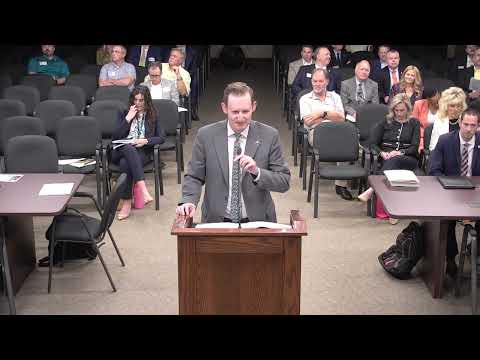
An Agile representative (identified in the transcript as SPEAKER 3) described the Space Test Center as a multi‑bay facility designed to test small satellite propulsion engines in vacuum conditions. The representative said the initial build includes one funded test bay and that the facility could host up to 20 test cells with the capacity for multiple engines per day. "We expect to be hiring hundreds to thousands of employees," the representative said, describing the facility as an anchor for an adjacent production ecosystem.
Commissioners probed project ownership and taxpayer protections. Commissioner Jerry Hunter asked who would own the facility and how the state would recover its investment if promised jobs and economic benefits did not materialize. The Agile representative said Agile will fund building infrastructure and hold a 30‑year land lease with Tulsa Airport while government funds and Agile funds support internal test infrastructure; he said specific grant terms and conditions, including clawback provisions, would be part of the grant agreement.
Director Ardies reaffirmed that the grant would include standard state terms, job thresholds and clawback opportunities to protect the state purse and said phase II expands capabilities already under construction in phase I. "There are clawback opportunities in those agreements to ensure that the state of Oklahoma is not going to be missing out on monies," Ardies said.
On the Will Rogers item, Joel Jamison of Jet Engine Test Solutions described acquiring and re‑siting a vintage T‑9 test cell to Will Rogers International Airport. Ardies said the department would participate in the engine test‑cell component of a larger campus project; the project's state share for the test‑cell element was presented as about $3.9 million of roughly $6.6 million in project costs tied specifically to the test‑cell component.
Commissioner Blake Raney moved to approve both items (8A and 8B); Commissioner Seth Phillips seconded. The commission approved the grants on a roll call vote with all commissioners present voting "aye." Staff said final award documents and specific terms and conditions will be completed before disbursement.
Why it matters: The approvals aim to position Oklahoma as a hub for both aircraft engine MRO and emerging in‑space propulsion testing—sectors the commission said will generate local jobs and industry clustering. Commissioners emphasized the need for enforceable agreement terms to protect taxpayers and tie public funding to measurable outcomes.
Next steps: Staff will finalize grant agreements with specific performance provisions, clawback language and reporting requirements before releasing state funds.