Get Full Government Meeting Transcripts, Videos, & Alerts Forever!
Get email alerts on the Water Conservation topic
No spam. Unsubscribe anytime.
Commission advances water‑use element update, urges further work to meet state requirement
Summary
Planning staff said the city has a Division of Water Resources grant to update the water element of the general plan; commissioners recommended continued consideration of the amendment to meet Title 10, Chapter 20, Part 4, Section 404 UCA and asked staff for additional technical details on tiered rates, ERCs and incentives.
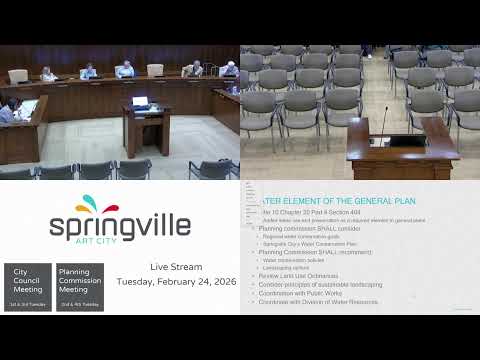
Carla, planning staff, told the commission that Springville received a grant from the Division of Water Resources to update the water element of the general plan and that state changes require the water element (and other elements) to be included in the current general‑plan update. Staff said the planning commission will recommend language to help the city comply with the statute and that a grant extension allows work to continue to February 28th for completion activity.
Staff described how the water conservation plan and the drinking‑water and pressurized‑irrigation master plans will inform the water element. She said the Provo River region target is 179 gallons per capita per day and that the draft proposes a reduction of about 4.89 gallons per day from the city’s baseline; staff said those metrics will be monitored and adjusted as needed.
Commissioners asked technical questions about equivalent residential connections (ERCs), tiered rates and how incentive programs would be funded. Carla and other staff said public works tracks meter reads and leak detection and that the council would decide whether to adopt incentives such as rip‑out programs or discounts for using pressurized‑irrigation systems. A commissioner asked whether allowing concrete in planter strips would undermine conservation; an exchange with staff included: "it is not legal to put concrete in your planter strip if it's over a certain width," a staff speaker said, noting specific code standards would control such changes.
Several commissioners emphasized that the general plan is advisory and that any regulatory changes (landscape code or incentive programs) would return separately to the commission and council as code amendments. After discussion, a commissioner (Ann) moved to recommend continued consideration of the water‑use and preservation element amendment to comply with Title 10, Chapter 20, Part 4, Section 404 UCA; the motion passed with no recorded opposition.
Next steps: staff will work with public works to supply additional technical data (metering, ERC calculations, buildout figures and potential cost estimates for incentive programs) and will return amendments as needed for code or policy decisions by the City Council.