Get Full Government Meeting Transcripts, Videos, & Alerts Forever!
Get email alerts on the Automated Enforcement topic
No spam. Unsubscribe anytime.
Portland hears vendor pitch on automated speed and red‑light enforcement as residents urge cameras for safety
Summary
Residents urged the town to install automated speed and red‑light enforcement after hearing a vendor presentation and a police update; town officials were told CT law and DOT permitting guide implementation, fines are civil, and the program would require traffic studies and public hearings before launch.
Residents and police officials pressed Portland leaders to consider automated traffic enforcement on the town’s most dangerous corridors at the board meeting, and a vendor demonstrated how a system would work.
Kathy Haron, a Homestead Village resident, told the board she supports red‑light and speed cameras and cited a Hartford Current report saying Middletown issued tens of thousands of citations at one Route 66 site and collected about $1.8 million in fines over a multi‑month period. "I strongly recommend that the Portland VOS move forward with obtaining approval for the use of these cameras and implement their use in the near future," Haron said.
The vendor presentation came from Datatech/Speed Enforcer representatives, who described a three‑step process—capture, review and processing, then notice—and said the software is built to preserve due process. "Our goal is to offer people proper due process," one presenter said, noting dual OCR, engineering calibration certificates for each site and annual recalibration requirements. The company said data for each jurisdiction is stored separately in Microsoft Azure Government Cloud and is not co‑mingled with other towns’ records.
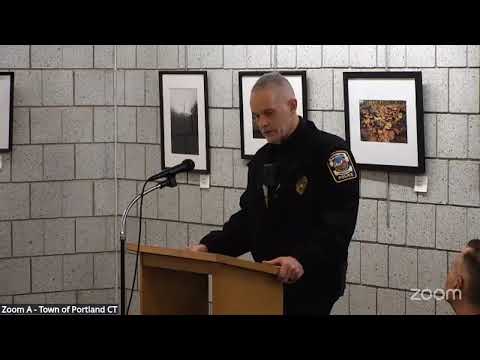
Police Captain Scott Cunningham said the department has already been testing related camera technologies and is moving to a solar‑powered equipment plan after utility companies changed pole‑attachment policies. Cunningham described an initial LPR deployment at the police building and identified three planned LPR sites and two additional roadway cameras. He also stressed limits on uses of LPR data: "Any information obtained that cannot be used for any investigative purposes—that's what the LPRs are for," he said, adding the program is focused on traffic enforcement.
Officials and the vendor walked through operational and legal details: CT law passed in 2023 requires community hearings, an ordinance and a DOT permit that is supported by traffic studies and engineering drawings. The vendor estimated DOT permitting takes roughly 60 days and an implementation timeline of about four to five months after contracting and permitting; the town's launch plan could be phased to limit initial volume. The fine structure described in the presentation was a $50 civil citation for a first offense and $75 on a subsequent offense, with a commonly applied $15 administrative fee; processing and retention rules in state law affect escalation and evidence availability.
Board members asked about workload and costs. The vendor said a trained processor can handle roughly 120 records an hour and that the system is typically funded from violator fees rather than an upfront capital outlay by the town. The vendor also described warranty and service agreements covering damaged equipment and maintenance SLA commitments.
What’s next: boardors asked staff to run pro bono traffic studies on candidate locations, collect additional Middletown data and invite Middletown officials for a future meeting to hear firsthand experience. The board signaled it will schedule public hearings and consider ordinance language if studies demonstrate a viable safety case.